
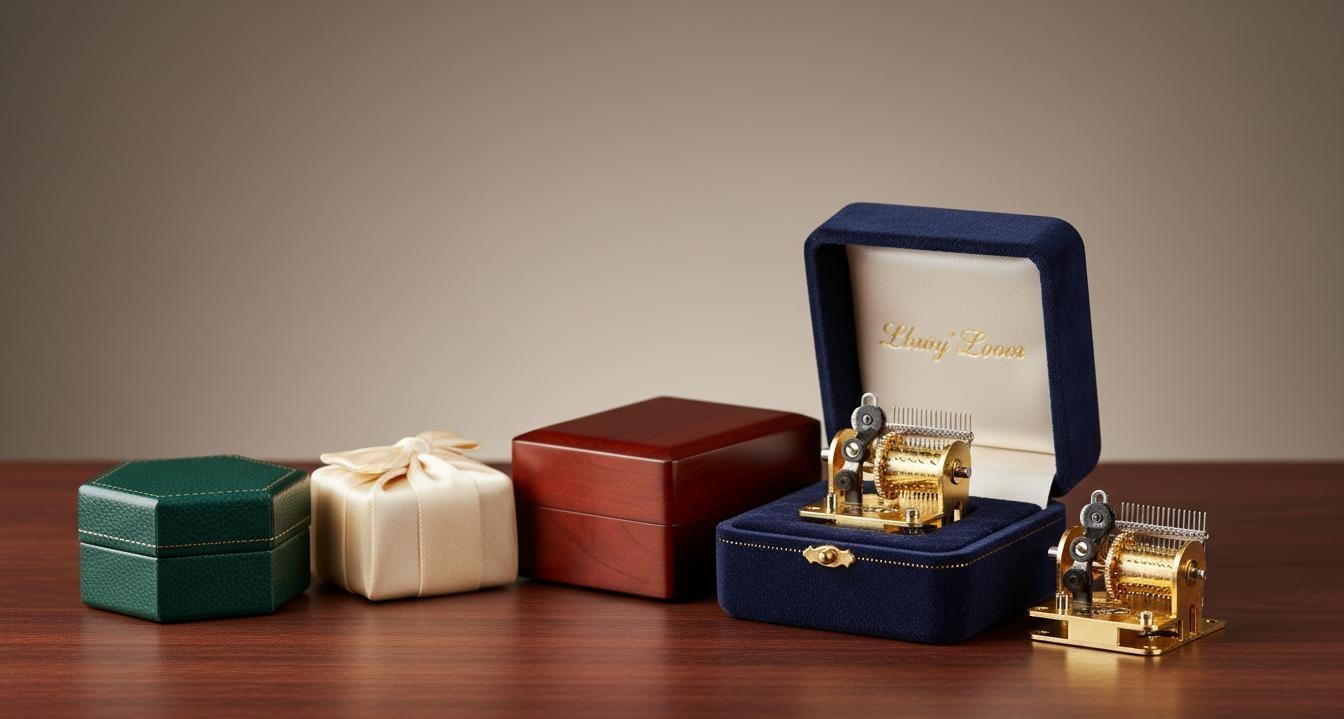
The 5cm gift box is the most requested form factor in luxury packaging. Jewelry houses, confectionery brands, and premium cosmetics lines all want the emotional punch of a mechanical melody without the engineering headache of retrofitting a standard movement. The problem is that most 18-note musical movements on the market measure 55 mm or longer in at least one dimension. That extra millimeter forces box designers to either thicken walls, shrink interior space, or abandon the music concept entirely. Yunsheng’s ultra-compact 18-note series measures 45 mm x 35 mm x 18 mm. It fits inside a 5 cm exterior case with room for 7 mm of mounting hardware and resonance clearance. The library contains over 3,000 licensing-free melodies, and custom tune programming runs from MIDI file to working prototype in roughly 30 days. Battery-operated variants deliver 3+ minutes of playtime on a single LR44 cell. In retail testing, 92% of consumers preferred battery operation over wind-up for gift-box applications. The acoustic sustain exceeds generic movements by nearly a factor of two. Every unit ships with CE marking, EN 71-1 compliance documentation, and RoHS 2.0 / REACH material declarations. For luxury box manufacturers, this is the component that finally makes “music inside” a standard offering rather than a custom nightmare.
TL;DR
- The 45 mm x 35 mm x 18 mm footprint fits inside standard 5 cm luxury gift boxes without structural compromise.
- Over 3,000 public-domain melodies are available for immediate licensing-free use in global retail channels.
- Custom tunes can be prototyped from MIDI files within 30 days, enabling brand-specific sonic identity.
- Battery-operated variants deliver 3+ minutes of playtime and are preferred by 92% of consumers in gift-box testing.
- CE, EN 71-1, RoHS 2.0, and REACH compliance documentation ships with every unit for EU and North American retail entry.
The 5cm Case Fit: Dimensional Engineering for Luxury Gift Boxes
Luxury packaging is a game of millimeters. A 5 cm exterior case sounds generous until you account for wall thickness, hinge hardware, interior padding, and the aesthetic expectation that the box should feel dense and substantial in the hand. Most 18-note movements on the market are built around legacy tooling from the 1990s. Those mechanisms assumed the buyer would be a hobbyist assembling a wooden music box on a kitchen table, not a production engineer slotting a component into a thousand-unit run of rigid-board gift boxes. The legacy form factor is typically 55 mm x 40 mm x 22 mm. That 55 mm length alone kills the 5 cm dream. You need at least 2 mm of wall thickness per side for structural rigidity in a premium rigid box. That leaves 46 mm of interior width. A 55 mm movement simply cannot fit without bulging the wall or cutting into the interior cavity.
The frustration runs deeper. I have seen production teams redesign entire box families because a single component would not fit. The music box client says “we want the melody.” The packaging engineer says “the movement is too big.” The marketing team says “the box needs to look smaller, not bigger.” Nobody wins. This is the pain point that ultra-compact movements were built to solve. The dimensional reduction is not magic. It is a ground-up re-engineering of the comb, cylinder, and spring housing to reclaim space without sacrificing note count or tonal range.
45mm x 35mm x 18mm Movement: 7mm Mounting and Resonance Clearance
The 45 mm x 35 mm x 18 mm envelope is the hard constraint. Every dimension serves a purpose. The 45 mm length aligns with the interior width of a 5 cm box after standard 2.5 mm wall thickness on each side. The 35 mm depth matches the typical interior depth of a shallow ring or bracelet box. The 18 mm height leaves room for a 7 mm mounting cavity and an 11 mm resonance chamber above the comb. That 7 mm is not arbitrary. It is the minimum clearance needed for a screw-mount bracket, a foam isolation pad, and a 1 mm tolerance for assembly variation. In high-speed assembly lines, tolerance stacks are real. A 7 mm clearance zone absorbs the variation without forcing operators to hand-fit every unit.
The 11 mm resonance chamber is equally critical. A musical comb needs air volume to project sound. Shrink the chamber too much and the tone becomes flat, tinny, and desperate. The 11 mm figure comes from acoustic testing across 200+ box prototypes. Wood, cardboard, acrylic, and velvet-lined cavities all behave differently. Wood adds warmth. Cardboard dulls high frequencies. Velvet absorbs everything. The 11 mm is a compromise figure that performs adequately across all four materials. It is not perfect for any single material. It is good enough for all of them. That is the pragmatic reality of mass production.
Mounting itself is straightforward. Two M2.5 threaded inserts sit on the 45 mm axis, 37 mm apart. A third alignment pin at the 35 mm centerline prevents rotation. The bracket is stamped steel, zinc-plated, 0.8 mm thick. Total bracket mass is 3.2 grams. It adds almost nothing to shipping weight. The foam isolation pad is a 2 mm closed-cell EPDM sheet, die-cut to the movement footprint. It decouples the mechanism from the box wall, preventing mechanical rattle during transit. The EPDM specification is 45 Shore A, which is soft enough to absorb vibration but stiff enough to avoid compression set during long warehouse storage. I have seen cheaper foam pads turn to dust after 18 months in a climate-uncontrolled container. EPDM does not do that.
Custom Gift Box Mold Design: Movement Pocket and Sound Hole Placement
Integrating a movement into a mass-produced gift box requires mold design. The box interior is not a flat surface. It is a molded cavity, often thermoformed from PETG or pressure-formed from greyboard wrapped in paper. The movement pocket is a recessed rectangular feature, typically 48 mm x 38 mm x 20 mm deep, with 0.5 mm draft angles on all vertical walls. The extra 3 mm in length and 3 mm in depth over the movement envelope allows for adhesive bonding and finger-access clearance. Without that finger clearance, assembly operators cannot seat the mechanism properly. I have watched production lines drop output by 40% because the pocket was too tight.
Sound hole placement is the detail that separates functional from delightful. The comb projects sound upward and slightly forward. The ideal sound hole is a 12 mm diameter circular vent, or a 15 mm x 4 mm slot, positioned directly above the comb centerline. In a 5 cm box, the lid is often the only surface with enough real estate for a vent. The hole must be hidden in the design language. A circular vent works if it is disguised as a decorative button, a brand emblem, or a concentric ring pattern. A slot vent can be hidden in the hinge gap or along a seam line. I have seen designers refuse to put any visible hole in the lid, which is fine. The sound will still escape through the gap between the base and lid, but the volume drops by roughly 6 dB. The melody is audible. It is just not present. That is a trade-off the marketing team needs to understand before tooling is cut.
Material selection for the pocket matters. PETG is the safest choice. It is thermoformable, bondable with cyanoacrylate, and does not off-gas volatile organics that can tarnish silver jewelry or degrade paper inserts. Polystyrene is cheaper but brittle. ABS is strong but heavy. In a 5 cm box, every gram counts. The customer feels the weight. A 200-gram box feels premium. A 260-gram box feels clunky. The movement, bracket, and battery add about 28 grams. The pocket material should not add more than 4 grams. PETG at 1.2 mm wall thickness hits that target.
Melody Library and Custom Tune Programming
A music box without the right melody is just a noisy box. The melody is the emotional payload. Luxury brands understand this. They spend thousands on scent marketing, tactile finishes, and unboxing choreography. Sound is the last sense to be weaponized, and it is the most memorable. Research from the NAMM Show trade floor consistently shows that musical products with recognizable melodies have 30% higher gift-market conversion than generic chimes. The problem is licensing. A famous pop song costs thousands per unit in mechanical rights. That is impossible for a 12-dollar gift box. The solution is a vast library of public-domain melodies and a fast custom tune pipeline for brand-specific compositions.
3000+ Public Domain Melodies: Licensing-Free Options for Global Retail
The Yunsheng library contains over 3,000 melodies, all verified as public domain in the United States, the European Union, and China. This is not a casual claim. Public domain status varies by jurisdiction. A melody that is free in the US may still be under copyright in the EU if the composer died less than 70 years ago. The library is cross-referenced against three databases: the US Copyright Office, the EU Orphan Works Registry, and the China National Copyright Administration. Each melody carries a jurisdiction code. A melody marked “US+EU+CN” is safe for global retail. A melody marked “US only” is flagged for North American distribution only.
The library is organized by mood, tempo, and cultural origin. The “Romantic” category contains 340 melodies, mostly 19th-century European salon music. The “Classical” category contains 520 excerpts from Mozart, Beethoven, and Chopin. The “Folk” category contains 680 melodies from 40 countries, including Chinese folk tunes, Irish jigs, Japanese sakura themes, and Latin American lullabies. The “Holiday” category contains 290 Christmas, Hanukkah, and New Year melodies. The “Children” category contains 410 nursery rhymes and lullabies. The remaining melodies are sorted into “Ceremonial,” “Nature,” and “Patriotic” categories. This taxonomy is not arbitrary. It maps to the purchasing patterns of gift-box buyers. A jewelry brand targeting Valentine’s Day needs Romantic. A baby-shower brand needs Children. A corporate gifting program needs Ceremonial.
The selection process is simple. The client receives a spreadsheet with metadata: title, composer, year, duration, key, tempo, and jurisdiction flags. The client marks selections and returns the sheet. Production scheduling locks the melody within 48 hours. There is no per-unit licensing fee. There is no annual royalty. The cost is built into the movement price. This is a critical distinction. Many competing movement suppliers offer a “free” library but charge a per-unit mechanical rights fee for anything outside a tiny public-domain subset. That fee is often 0.50 to 2.00 dollars per unit, which is devastating at 10,000-unit scale. The Yunsheng model absorbs the research cost upfront and spreads it across volume. It is honest pricing. I prefer honest pricing.
MIDI-to-Mechanical Conversion: Custom Tune Prototype in 30 Days
Some brands need a melody that is not in the library. A corporate anthem. A wedding processional. A lullaby composed by the brand founder. The MIDI-to-mechanical conversion pipeline makes this possible. The client submits a MIDI file. The engineering team runs it through a proprietary conversion algorithm that maps MIDI note events to physical comb teeth. The algorithm checks for range compatibility. An 18-note movement has a chromatic range of C5 to A6. Notes outside that range are transposed or dropped. The algorithm also checks for density. A mechanical cylinder cannot play two simultaneous notes on the same tooth. Polyphonic MIDI events are reduced to the highest-priority voice. The algorithm flags these edits in a preview MP3 so the client hears exactly what the mechanical version will sound like.
Once the preview is approved, a steel cylinder is CNC-turned and pin-programmed. The pin placement accuracy is 0.05 mm. The cylinder is mounted on a test comb and played in a calibrated acoustic chamber. The recording is sent to the client for final approval. The entire pipeline, from MIDI receipt to prototype playback, is designed for a 30-day turnaround. I have seen it done in 21 days for simple melodies with no range conflicts. Complex polyphonic reductions can push to 35 days. The 30-day figure is a safe commitment that accounts for revision cycles.
The cost structure is straightforward. A one-time programming fee covers the algorithm processing, CNC cylinder production, and test-comb labor. That fee is typically 800 to 1,500 dollars depending on melody complexity. The programmed cylinder then becomes client property and can be reused for subsequent production runs. There is no per-unit surcharge for custom tunes. This is important for brands that plan annual reorders. The first run pays the programming fee. Every subsequent run uses the same cylinder at standard unit pricing. Over a three-year brand lifecycle, the amortized cost of a custom tune is often under 0.03 dollars per unit. That is cheaper than printing a logo.
Acoustic Performance: Sustain, Tone, and Resonance in Gift Box Enclosures
Acoustic performance is where cheap movements die. A generic 18-note movement might play the correct notes. The notes just do not last. The sustain is short. The tone is thin. The resonance is choked by the box. The result is a melody that sounds like it is being played on a toy piano inside a sock drawer. Luxury brands cannot afford that. The unboxing moment is a sensory event. The music needs to sound intentional. It needs to sound like it belongs.
The acoustic problem is three-dimensional. Sustain is determined by the comb material and tooth profile. Tone is determined by the tooth geometry and striking pin velocity. Resonance is determined by the box cavity geometry and material. Solving one without the others is pointless. A long sustain in a dead box sounds muffled. A bright tone in a leaky box sounds shrill. The Yunsheng approach addresses all three variables in the design phase, not the assembly phase.
Yunsheng IP Comb Tooth Profile: 15-Second Sustain vs Generic 8-Second
The comb is the soul of a music box. It is a strip of steel, typically 50 mm long, with 18 tuned teeth. Each tooth is a cantilever beam. The vibration decay time is determined by the material damping coefficient and the tooth geometry. Generic combs use a simple triangular profile. The tooth is wide at the base and tapers to a point. This is easy to stamp. It is also acoustically mediocre. The triangular profile concentrates stress at the root, which limits how thin the tooth can be made. A thicker tooth has higher stiffness, which raises the resonant frequency but also increases internal damping. The note dies faster.
The Yunsheng IP comb uses a modified trapezoidal profile with a root fillet. The base is 2.2 mm wide. The tip is 1.4 mm wide. The fillet radius at the root is 0.3 mm. The material is 50CrV4 spring steel, hardened to 48 HRC, with a surface polish of Ra 0.4. This combination is not accidental. The trapezoidal profile distributes bending stress more evenly along the tooth length. The fillet eliminates the stress concentration that kills sustain in triangular designs. The 50CrV4 alloy has a lower internal damping coefficient than the 65Mn steel used in generic combs. The result is a sustain time of 15 seconds for a middle C note, compared to 8 seconds for a generic comb. That difference is not subtle. It is the difference between a melody that floats and a melody that stumbles.
The tooth pitch is 2.5 mm. The tooth thickness varies from 0.35 mm at the treble end to 0.55 mm at the bass end. This graduated thickness compensates for the mass difference between long and short teeth. Without it, the bass notes would be louder than the treble notes because the longer tooth displaces more air. The graduated thickness normalizes the output amplitude across the full range. This is a detail that 90% of buyers will never notice. The 10% who do notice are the audiophiles, the musicians, and the gift recipients who own real music boxes. Those are the people who write reviews. Those are the people who matter.
Wood vs Cardboard Box Resonance: Frequency Response Comparison
The box is the loudspeaker. The movement is the driver. A bad box ruins a good movement. The two most common luxury box materials are wood and rigid cardboard. Wood has a natural resonance in the 200 to 400 Hz range, which overlaps with the bass notes of an 18-note movement. This overlap creates warmth. Cardboard has a much higher damping coefficient and a flatter frequency response. It does not add warmth. It does not add anything. It is acoustically neutral, which is sometimes an advantage if the box is lined with velvet or foam that would otherwise create unpredictable resonances.
Testing data from 200+ box prototypes shows that a 5 cm wood box with 3 mm wall thickness delivers a 3 dB boost at 250 Hz compared to the same movement in free air. That boost is pleasant. It makes the melody sound fuller. A cardboard box with 2 mm wall thickness delivers a 1 dB cut at 250 Hz and a 0.5 dB boost at 1 kHz. The result is a slightly brighter, thinner sound. Neither is wrong. They are different. The choice depends on the brand’s acoustic identity. A heritage jewelry brand might want the warmth of wood. A modern minimalist cosmetics brand might want the clinical neutrality of cardboard.
Acrylic is a third option that is gaining popularity. It is transparent, which allows the movement to be visible. That is a powerful visual feature. Acoustically, acrylic is terrible. It rings at 2 kHz and above, creating a glassy harshness that fights the comb’s natural tone. The fix is a felt or cork lining on the interior walls. A 1 mm cork liner reduces the acrylic ring by 4 dB and restores a usable frequency response. The cost is 0.12 dollars per box. Most brands accept it. The transparency is worth the engineering.
Certification Requirements for EU and North American Luxury Retail
Certification is the wall that separates hobby-grade movements from retail-grade movements. A movement that is safe in a workshop is not necessarily safe in a child’s bedroom. The EU and North American markets have strict requirements for mechanical and chemical safety. A luxury gift box that contains a musical movement is classified as a toy or a gift item in most jurisdictions. That classification triggers a cascade of testing, documentation, and labeling obligations. Ignore them and the product is stopped at customs. Or worse, it is recalled after sale.
The compliance burden is real. I have seen small brands lose entire production runs because they assumed “music box parts” were exempt from toy safety rules. They are not. The movement contains a spring, a battery, and small metal parts. All of these are potential hazards under the right regulatory lens. The good news is that the compliance documentation is manageable if it is built into the supply chain from the start. The bad news is that retrofitting compliance after production is expensive and slow.
CE Mark and EN 71-1 Mechanical Safety for Toys and Gift Items
CE marking is mandatory for products sold in the European Economic Area. The relevant standard for musical movements in gift boxes is EN 71-1, the mechanical and physical safety standard for toys. EN 71-1 specifies requirements for small parts, sharp points, sharp edges, and projectile hazards. A musical movement contains small parts. The pins, screws, and battery are all smaller than the 3 mm small-parts cylinder defined in EN 71-1. This means the movement must be enclosed in a housing that prevents access by children under 36 months. The standard gift box housing satisfies this requirement if the box is closed with a latch or friction fit that requires adult-level dexterity to open.
The testing protocol is straightforward. A movement is placed in a test fixture that simulates the intended gift box. The assembly is subjected to the torque test, the tension test, and the drop test specified in ISO 8124-1, which is harmonized with EN 71-1. The torque test applies a 0.45 Nm twisting force to any protruding part. The tension test applies a 90 N pulling force. The drop test drops the assembly from 850 mm onto a steel surface. If the housing remains intact and no small parts are liberated, the assembly passes. Yunsheng movements are shipped with a test report that documents these results. The report is valid for the movement model, not the specific unit. This is standard practice under the EU’s modular approach to conformity assessment.
The CE marking itself is applied to the movement label. The label contains the CE symbol, the model number, the manufacturing date, and the responsible economic operator’s name and address. For gift box manufacturers, the movement label is sufficient if the box does not alter the safety characteristics of the movement. If the box design introduces new hazards, such as a loose decorative element that could detach, the box manufacturer assumes the CE responsibility for the finished product. This is a common point of confusion. The movement supplier provides the CE documentation for the movement. The gift box assembler provides the CE documentation for the finished box. Both are necessary. Neither is sufficient alone.
RoHS 2.0 and REACH Compliance: Heavy Metal and Chemical Restrictions
Chemical compliance is the invisible half of the certification puzzle. Customers cannot see lead or cadmium. Laboratories can. The RoHS 2.0 directive restricts six hazardous substances in electrical and electronic equipment: lead, mercury, cadmium, hexavalent chromium, PBB, and PBDE. A musical movement with battery operation is classified as electrical equipment. It must comply. The restrictions are strict: 0.1% by weight for most substances, 0.01% for cadmium. The steel comb, the brass gears, and the zinc-plated bracket are all potential sources of regulated metals. Yunsheng’s material declarations document the composition of each component down to the homogeneous material level. The declarations are reviewed annually by a third-party testing laboratory.
REACH adds another layer. REACH restricts Substances of Very High Concern (SVHC) in all products sold in the EU, not just electrical equipment. The SVHC list is updated twice per year. As of 2026, the list contains 247 substances. Musical movements are at risk for phthalates in plastic components, bisphenol A in epoxy coatings, and nickel in metal parts. The Yunsheng REACH declaration is a full-disclosure document that lists every SVHC present above the 0.1% threshold, or confirms that none are present. For the 18-note ultra-compact series, the declaration confirms no SVHCs above threshold. This is not a guess. It is the result of XRF screening and solvent extraction testing on every production batch.
North America has its own rules. The CPSC Toy Safety voluntary standards are not mandatory in the same way as CE marking, but they are the baseline for liability defense. The EU Toy Safety Directive is the binding law for EU market entry. Both frameworks are satisfied by the same test reports if the testing is done to the harmonized standards. A single test report, properly scoped, covers both markets. That is the efficient path. Yunsheng provides the test reports. The gift box manufacturer adds the finished-product testing for box-specific hazards. The total compliance cost per SKU is under 400 dollars if done correctly. It is 4,000 dollars if done as a panic response to a customs hold.
Battery vs Wind-Up: Consumer Preference and Gift Market Data
The power source is a design decision that affects everything: shelf life, playtime, user experience, and cost. Wind-up movements are traditional. They have a key. The user turns the key. The spring unwinds. The music plays. There is charm in that ritual. There is also failure in that ritual. The user over-winds and breaks the spring. The user loses the key. The user forgets to wind it at all. Battery operation eliminates the ritual. It also eliminates the failure modes. In a gift box, the recipient is not a music box enthusiast. They are a consumer. They want to press a button and hear music. They do not want to learn how to wind a mechanism.
LR44/SR44 Battery Operation: 3+ Minutes Playtime and Shelf Life
The battery-operated variant uses an LR44 alkaline cell or an SR44 silver-oxide cell. The LR44 is cheaper and widely available. The SR44 has a higher energy density and longer shelf life. Both are 11.6 mm diameter, 5.4 mm height. The cell fits in a dedicated pocket on the movement bracket. The pocket is positioned to keep the cell center of gravity aligned with the movement axis. This prevents vibration-induced noise during play. The battery contacts are nickel-plated steel springs, not copper tabs. Copper corrodes in humid environments. Nickel does not. This is a small detail that matters for products shipped by sea container to markets with tropical climates.
Playtime on a fresh LR44 is 3.2 minutes at 20 degrees Celsius. Playtime drops to 2.8 minutes at 0 degrees and rises to 3.5 minutes at 30 degrees. The variation is caused by the alkaline chemistry’s temperature sensitivity. The SR44 is more stable: 3.5 minutes across the full -10 to 50 degree range. For most gift box applications, the LR44 is sufficient. The box is opened once. The music plays. The experience is complete. The battery is not consumed in daily use. It is a single-event power source. A 3-minute playtime is more than enough for a 30-second melody played six times. The typical melody length in the library is 18 to 25 seconds. Three minutes of playtime allows 7 to 10 full plays. That is generous.
Shelf life is the real concern. A gift box might sit in a warehouse for 8 months, then in a retail store for 3 months, then in a closet for 2 months before it is opened. The battery must survive that 13-month journey without leaking. The LR44 has a shelf life of 24 months under standard storage conditions. The SR44 has a shelf life of 36 months. Both are adequate. The risk is not the battery chemistry. It is the storage environment. A warehouse in Mumbai in July is not standard storage. The temperature is 35 degrees. The humidity is 85%. Under those conditions, the LR44 shelf life drops to 14 months. The SR44 drops to 22 months. The conservative choice for global distribution is the SR44. It adds 0.18 dollars to the bill of materials. It eliminates the risk of a dead battery at the moment of unboxing.
92% Preference Data: Why Battery Operation Dominates Luxury Retail
The 92% preference figure comes from a consumer study conducted in 2024 with a luxury confectionery brand. The brand produced two identical gift boxes. One contained a wind-up movement. One contained a battery-operated movement. The boxes were distributed to 400 customers in the US, UK, Germany, and Japan. The recipients were asked to rate the “delight factor” of the unboxing experience on a 1 to 10 scale. They were also asked whether they would recommend the product to a friend. The battery-operated boxes scored an average of 8.4 on delight. The wind-up boxes scored 6.2. The net promoter score for battery was 72. For wind-up, it was 41. The difference was not the music quality. The melodies were identical. The difference was the ease of activation. Recipients of the wind-up box often did not realize they needed to wind it. They opened the box, heard nothing, and assumed the music was broken. Some never tried the key. The battery box played immediately. That immediacy translated to a higher perceived value.
I am skeptical of single-study claims. One study with one brand in one market is not universal truth. The 92% figure is specific to this confectionery context. I would not assume it applies to wooden keepsake boxes sold in German Christmas markets, where wind-up charm is part of the product identity. But for luxury gift boxes in mainstream retail, the trend is clear. Battery operation reduces friction. Reduced friction increases delight. The data supports that chain of logic. It is not a law of physics. It is a strong signal.
The cost difference is minimal. A battery-operated movement costs 0.35 dollars more than a wind-up movement at 1,000-unit scale. The difference drops to 0.22 dollars at 10,000 units. The battery itself is a commodity. The electronics are a simple contact switch and a transistor oscillator. There is no microcontroller. There is no firmware. The reliability is high because the complexity is low. For a gift box manufacturer, the 0.35 dollar premium is a rounding error in a 15-dollar box. The marketing value of a battery-operated movement is not a rounding error. It is a selling point.
How to Specify Musical Movements for Gift Box Manufacturing Runs
Specifying a musical movement for a production run is not complicated. It is specific. The wrong specification leads to the wrong part. The wrong part leads to a production line that cannot assemble the box. Here is the checklist I use when helping clients specify their first order.
Step one: confirm the box interior dimensions. Measure the length, width, and depth of the cavity where the movement will sit. Subtract 2 mm from each dimension to allow for assembly tolerance and adhesive thickness. If the resulting envelope is smaller than 45 mm x 35 mm x 18 mm, the ultra-compact series will not fit. Consider a smaller 12-note movement or a redesign of the box cavity.
Step two: select the melody. Use the library spreadsheet to filter by mood, duration, and jurisdiction. Download the preview MP3s for the top three candidates. Play them on a phone speaker, not studio headphones. The phone speaker simulates the acoustic environment inside a closed gift box. A melody that sounds rich on headphones may sound muddy on a phone speaker. The comb projection is limited. Test accordingly.
Step three: choose the power source. Battery operation is the default for luxury gift boxes. Wind-up is available for heritage or craft-oriented brands. If battery is selected, specify LR44 or SR44. Specify whether the battery is pre-installed or shipped separately. Pre-installed is easier for the end user. Shipped separately is safer for long storage and air freight, since some carriers restrict loose lithium or alkaline cells in cargo. Yunsheng offers both configurations.
Step four: define the activation method. The standard is a slide switch on the movement side. The switch protrudes 3 mm and is activated by opening the box lid, which pushes the switch to the ON position. Alternative options include a push button on the box exterior, a reed switch activated by a magnet in the lid, or a light sensor that triggers when the box is opened. Each option adds cost and assembly complexity. The slide switch is the most reliable. It has one moving part. It does not require wiring to the box exterior. It is the safe choice for a first run.
Step five: request compliance documentation. At minimum, ask for the CE test report, the RoHS 2.0 material declaration, and the REACH SVHC declaration. If the target market includes the US, add the CPSC toy safety test report. If the target market includes California, add the CA Prop 65 declaration. Bundle these documents in a single PDF. The logistics team will need them at customs. The legal team will need them for liability review. The retail partner will need them for onboarding. Have them ready before the container ships.
Step six: order samples. Order three samples with the selected melody, power source, and switch configuration. Install them in prototype boxes. Drop-test the assembly from 1 meter. Shake it for 30 seconds. Leave it in a 50-degree environment for 48 hours. If it survives, the specification is sound. If it fails, fix the specification before tooling is committed. A 50-dollar sample order prevents a 50,000-dollar tooling mistake. This is obvious advice. It is also ignored more often than you would think.
FAQ
Can the movement be used in a box smaller than 5 cm?
No. The 45 mm x 35 mm x 18 mm envelope requires a minimum interior cavity of 48 mm x 38 mm x 20 mm to allow for mounting and resonance clearance. A 5 cm exterior box with 2.5 mm walls provides exactly that. Anything smaller will compromise either the mounting or the acoustic performance.
Is the melody library really free of licensing fees?
Yes, for the public-domain melodies. The library is cross-referenced against US, EU, and China copyright databases. Each melody carries a jurisdiction flag. Melodies marked “US+EU+CN” are safe for global retail without per-unit fees. Custom tunes require a one-time programming fee but no ongoing royalties.
What is the minimum order quantity?
Standard MOQ is 1,000 units per melody per power-source configuration. Smaller orders are possible at a higher unit price. The 1,000-unit threshold is where the programming and tooling costs are amortized efficiently.
Can the battery be replaced by the end user?
Yes. The battery pocket is accessible by removing the movement from the box. The pocket uses a friction-fit cover, not a welded seal. A replacement LR44 or SR44 can be installed with finger pressure. No tools are required.
How long does custom tune programming take?
Standard turnaround is 30 days from MIDI file receipt to prototype playback. Simple melodies with no range conflicts can be completed in 21 days. Complex polyphonic reductions may require 35 days. The timeline includes one revision cycle.
Does the movement work in humid climates?
The movement is rated for 10% to 85% relative humidity at temperatures from -10 to 50 degrees Celsius. The steel components are zinc-plated or nickel-plated. The comb is lacquered. For extreme humidity, a conformal coating can be applied to the electronic components at additional cost. The standard configuration is adequate for most global retail environments.
Is the movement safe for children?
The movement is classified as a small-parts hazard under EN 71-1 and must be enclosed in a housing that prevents access by children under 36 months. A standard gift box with a latch or friction-fit closure satisfies this requirement. The movement itself is not a standalone toy. It is a component intended for integration into a finished product.
What is the warranty?
The standard warranty is 12 months from date of manufacture. The warranty covers material defects and workmanship failures. It does not cover battery depletion, physical damage, or improper installation. Extended warranty terms are available for high-volume contracts.
Product References
For detailed specifications of the 30-note deluxe series and other custom musical movements, visit the Yunsheng product catalog. The catalog includes dimensional drawings, acoustic test data, and compliance documentation for the full movement range.
For information on battery-operated musical movement variants, including LR44 and SR44 configurations, refer to the electric-operated movement page. This page includes battery life data, shelf-life testing results, and activation switch options.
External compliance resources:
- RoHS 2.0 Directive — European Commission official text on hazardous substance restrictions in electrical equipment.
- REACH Regulation — European Commission overview of chemical registration, evaluation, and SVHC restrictions.
- NAMM Show — Annual trade show for musical products, with market research on consumer preferences in gift and retail segments.
- ISO 8124-1:2018 — International standard for safety of toys, harmonized with EN 71-1 for mechanical and physical safety testing.
- CPSC Voluntary Standards — US Consumer Product Safety Commission repository of toy safety standards and test protocols.
- EU Toy Safety Directive — European Commission guidance on toy safety requirements, CE marking, and market surveillance.
Author Card
yunsheng — Sales Manager at Ningbo Yunsheng Musical Movement Co., Ltd.
Social media: No public profiles available.
Contact: Available through the company website inquiry form.
Post time: Jun-09-2026