
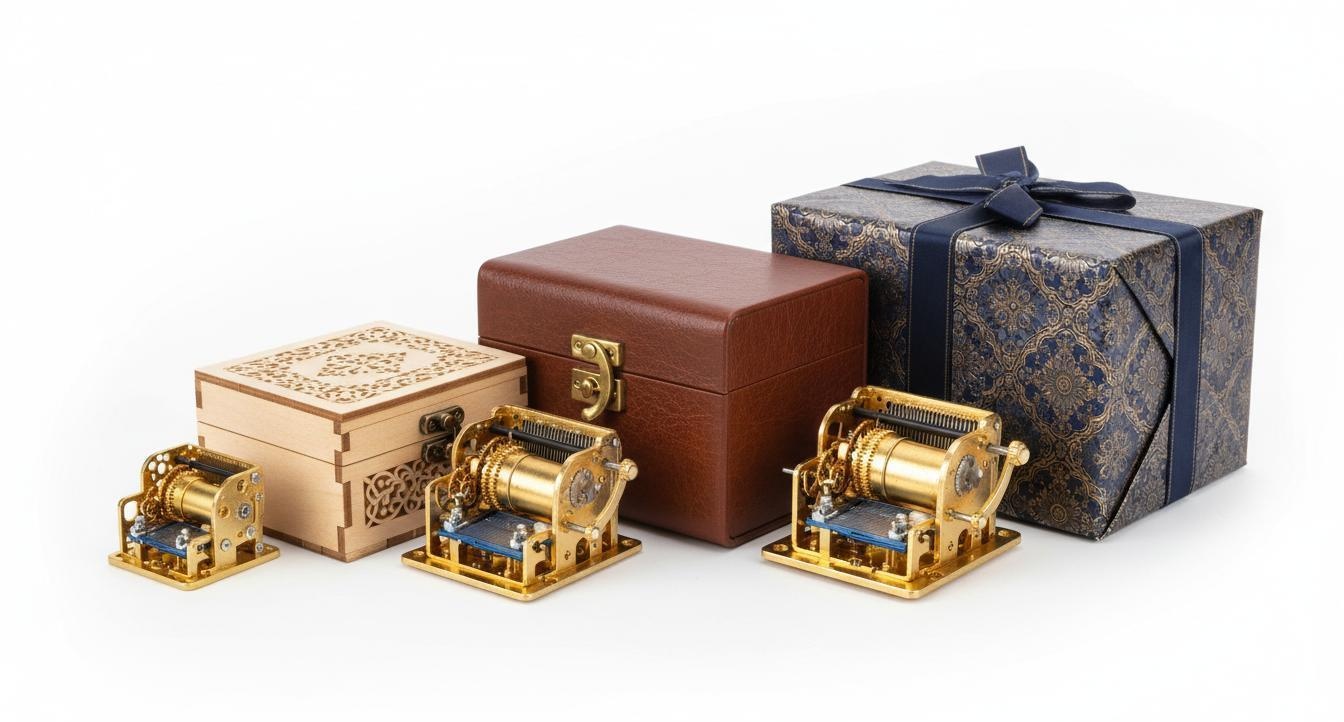
- Mechanism-to-box fit is the single most engineering-critical decision in music box product design — a movement that doesn’t fit voids a 10,000-unit order faster than any quality defect.
- Custom melody process takes 5-7 days for sample approval (standard) or 10-15 days (complex orchestral), with 20-30 days production lead time after approval.
- Spring tension increases from ~0.8N (18-note) to ~1.5N (36-note) — higher tension means richer sound but requires more physical effort to wind.
- Standard tolerances are plus or minus 0.3mm on movement dimensions — always design your box interior with this margin in mind, not as an afterthought.
- Working with a custom music box movement manufacturer like Yunsheng — with 4,000+ melodies and in-house R&D for custom programs — eliminates the melody-to-housing coordination nightmare that derails most custom projects.
Why Mechanism-to-Box Fit Matters More Than Anything Else
In 2021, we received an urgent call from a brand in Germany that had just received their first production shipment of 10,000 units. Their product: a premium anniversary music box retailing at EUR 65. Their problem: the movement they’d spec’d — a 30-note deluxe from our catalog, the Y30B3 — didn’t fit their box.
The issue wasn’t the movement. The issue wasn’t the box. The issue was the gap between them. Their industrial designer had worked from a competitor’s dimension sheet (inches, not millimeters) and had built their housing tooling around an assumed 2.75-inch movement width. The Y30B3 is 70mm — which is 2.76 inches. Close enough in theory. But the tolerance stack-up across the full assembly made the actual dimensional variation land just outside their acceptable range. The movement rattled inside the box. The sound was muffled. The aesthetic was ruined.
The resolution cost them EUR 43,000 in tooling modifications, delayed their market entry by 14 weeks, and nearly killed a product line they’d invested two years developing. That story is why I write articles like this one — because the problem wasn’t a mystery. It was a preventable engineering mistake that any custom music box movement manufacturer could have helped them avoid with five minutes of dimension-sheet review.
When you work with a custom music box movement manufacturer, the movement dimension sheet is your first and most important reference document. Not your box design. Not your aesthetic vision. The dimension sheet. Everything else follows from that.
Reading the Dimension Sheet: What to Measure Inside the Box
Every Yunsheng movement datasheet lists three critical dimensions: length (L), width (W), and height (H). These are the external envelope dimensions of the assembled movement — the space the movement physically occupies when seated in its housing. Here is what each dimension maps to inside your box:
Length (L): The Rotational Axis Dimension
The length dimension corresponds to the axis of the spring drum — the component that rotates when the movement plays. Because the drum must have clearance to rotate freely without contacting the box walls, you need to measure the interior length of your box along the axis where the drum will sit. The movement’s listed length is the minimum interior length you need.
In practice, we recommend adding a minimum of 4mm to the movement’s listed length dimension to account for movement seating variation and any padding or foam that may surround the mechanism.
Width (W): The Comb Clearance Dimension
The width dimension is the most frequently misunderstood — and the most common source of fit failures. The width measurement includes the full comb assembly, which extends slightly beyond the main housing on some models. Because the comb vibrates when struck by the drum pins, any contact with box walls dampens the sound and can eventually damage the comb teeth.
For the Y30B3 (70mm width), we recommend an interior clearance of at least 76mm. For the 3YA2026 (44.5mm width), allow at least 49mm. These aren’t arbitrary numbers — they include the 0.3mm standard tolerance on each dimension.
Height (H): The Crank Clearance Dimension
The height dimension is where many designers overlook clearance for the winding key or crank mechanism. Some movements have the crank on the top face; others have it on the side. Because the winding mechanism must rotate freely without contacting the box lid or side walls, measure the total envelope the movement requires during the full cranking cycle.
For movements with side-mounted cranks, the height dimension may be less critical than the width. For movements with top-mounted cranks (common on 36-note premium models), the interior height of your box must accommodate both the movement body and the full rotation arc of the crank.
Interior Clearance Quick Reference
| Movement Model | Listed Dimensions (mm) | Recommended Interior Clearance (mm) | Interior Volume Needed (cc) |
|---|---|---|---|
| 3YA2026 (18-note) | 50.5 x 44.5 x 34.5 | 55 x 49 x 38 | ~103 |
| Y30B3 (30-note) | 70 x 56 x 33 | 76 x 62 x 38 | ~180 |
| 36-Note Premium | ~80 x 60 x 35 | 88 x 66 x 42 | ~244 |
| Electric-Operated (Standard) | 65 x 50 x 18 | 72 x 56 x 24 | ~97 |
These clearance numbers assume a rigid box material (wood, rigid plastic, metal). For软体材料如泡沫或织物内衬, increase clearance by an additional 3-5mm per surface in contact with the lining.
Spring Tension and Cranking Force: How It Affects User Experience
The spring inside a music box movement stores mechanical energy when you wind the crank. The force required to wind the spring — the cranking force — is a critical user experience parameter that many product designers overlook until they receive field feedback.
Cranking Force by Movement Type
| Movement Type | Approximate Cranking Force | User Experience | Best Suited For |
|---|---|---|---|
| 18-note (standard) | ~0.8N | Light, easy cranking — suitable for children and elderly users | Keychains, children’s gifts, elderly-targeted products |
| 30-note (deluxe) | ~1.2N | Moderate resistance — requires deliberate winding motion | General adult gifts, wedding favors, collectibles |
| 36-note (premium) | ~1.5N | Full resistance — requires strength to fully wind | Luxury products, adult collectors, novelty items |
Because spring tension directly determines playback duration, you cannot simply “downgrade” to a lighter spring to make cranking easier without sacrificing melody length. The spring tension and the playback duration are inherently linked: a lighter spring winds easier but depletes faster.
If you’re designing a product for a specific demographic — elderly users at a nursing home, children under age 8, or users with limited hand mobility — communicate this to your custom music box movement manufacturer upfront. Yunsheng’s engineering team can discuss spring tension trade-offs and, in some cases, explore modified spring rates for specific applications.
The Custom Melody Process: Step-by-Step with Realistic Timelines
Custom melody programming is one of the most common reasons brands engage a custom music box movement manufacturer rather than buying from a catalog. The ability to put your proprietary melody — a brand anthem, a wedding song, a lullaby — inside a music box creates a product that cannot be replicated by any competitor browsing a catalog. Here’s the exact process we walk our customers through:
Step 1: Initial Consultation and Melody Assessment (Days 1-2)
Contact our sales team with your melody requirements. You can provide:
- MIDI file (preferred): A digital music file that provides exact pitch and timing data for each note. This produces the most accurate translation to pin drum programming.
- MP3 or audio reference: An existing recording of the melody you want programmed. Our engineers transcribe and adapt it for the movement’s note constraints.
- Sheet music or musical notation: If you have formal music notation, our engineering team can interpret it for movement programming.
Because the movement’s note count limits harmonic complexity, our team will assess whether your melody is technically feasible in the movement type you’ve selected. A full orchestral arrangement cannot be faithfully reproduced on an 18-note movement — we’ll tell you honestly whether your melody needs simplification or a higher-note-count movement.
Step 2: Engineering and Pin Drum Programming (Days 3-9 for standard custom, Days 3-17 for complex)
Once you’ve confirmed the melody and movement type, our R&D team programs the pin drum arrangement. This involves:
- Analyzing the melody’s pitch range and mapping it to the movement’s available notes
- Determining which simultaneous notes can be played in the movement’s harmonic structure
- Programming the drum pins in the precise sequence and timing required
- Running a virtual simulation to verify playback integrity before physical sample production
For the Y30B3 30-note deluxe movement, standard custom melodies complete this phase in 5-7 days. Complex orchestral pieces with multiple simultaneous voice lines may require 10-15 days. We communicate the expected timeline upfront before you commit.
Step 3: Sample Production and Shipment (Days 10-16 or 18-24)
A sample movement with your custom melody is assembled and shipped to you for approval. Sample fees are charged at this stage (typically USD 150-300 depending on melody complexity). Because we want you to verify the sound before committing to production, we strongly recommend listening to the sample in the actual box or a box of similar interior volume before approving.
Pay attention to: melody completeness (does it play the full intended phrase?), harmonic quality (does it sound like the original?), and volume level (is it appropriately loud for the box acoustics?). Small adjustments to the movement’s positioning inside the box can affect acoustic performance.
Step 4: Approval and Production (20-30 Days After Approval)
Upon your written approval of the sample, we schedule production. Standard lead time is 20-30 days for orders up to 10,000 units. Larger orders (50,000+ units) typically require 35-45 days. We provide production milestone updates at the 50% completion mark and one week before shipment readiness.
Sample fees are credited against your production order invoice if the order quantity meets our credit threshold (typically 5,000+ units for custom melody programs).
Custom Branding: Logo Plates, Housing Color, and Custom Packaging
Beyond the melody itself, a custom music box movement manufacturer can support several additional branding elements that elevate the product from commodity to custom:
Custom Logo on Movement Plate
Available for orders of 1,000+ pieces per SKU, we can engrave or screen-print your brand logo onto the visible movement plate. Because this is a visible component of the finished product, even when the box is closed, logo’d movement plates create a premium perceived value that justifies a higher retail price point.
The standard plate material is zinc-alloy, compatible with engraving, screen printing, and laser marking. We provide artwork specifications and a proof for your approval before production.
Custom Housing Color and Material
For orders of 5,000+ pieces per housing design, Yunsheng offers custom housing options including:
- Custom housing colors: We can match your brand’s Pantone color specification for the movement housing. Standard finish is matte black or silver zinc-alloy; custom colors require paint matching and may extend tooling lead time by 2-3 weeks.
- Custom housing materials: For premium products, we offer metal (brass, stainless steel) housing options with custom finishes. These are priced accordingly but create a premium tactile experience that distinguishes the product at retail.
- Custom housing geometry: Fully custom housing shapes require new tooling (Mold Tooling). For orders exceeding 20,000 units, custom tooling costs become economically justifiable. For smaller volumes, we recommend working with our existing housing catalog and optimizing your box design around standard movement footprints.
Custom Packaging and Insert Design
We work with your packaging supplier to ensure the movement ships in a configuration optimized for your final assembly process. This includes:
- Custom polyfoam inserts sized to your box interior
- Movement orientation indicators on packaging for assembly efficiency
- Batch numbering for quality traceability
MOQ Negotiation Strategies for Custom Orders
Minimum order quantities exist because custom manufacturing requires fixed cost investments (tooling, programming, setup) that must be amortized across a sufficient number of units to be economically viable for the manufacturer. Understanding why MOQs exist is the first step toward negotiating them intelligently.
Strategy 1: Commit to a Larger Follow-On Order
If you need 2,000 units of a custom-melody movement but the MOQ is 5,000, offer the supplier a commitment for 5,000 units total across two shipments. Because the fixed setup cost is amortized over a larger total volume, many manufacturers will accept a lower initial shipment MOQ in exchange for a binding commitment to a larger total order. Yunsheng regularly accommodates this type of arrangement for customers with strong credit history.
Strategy 2: Phase the Customization
Instead of committing to 5,000 custom-logo movements upfront, start with our standard catalog movements for your first order and apply custom branding (logo plate, custom packaging) to a smaller initial batch. Once you’ve validated market demand, scale into full custom housing and melody for the replenishment order.
Strategy 3: Group Similar Customizations
If you have multiple product lines that require custom movements, group them into a single custom program. Because the setup cost is incurred once regardless of how many SKUs are programmed, combining three similar custom movements into one program can reduce the effective per-unit custom engineering cost significantly.
Strategy 4: Offer Faster Payment Terms
For customers willing to pay in advance or via Letter of Credit at sight, some manufacturing cost premium can be negotiated in exchange for reduced financial risk to the supplier. This is particularly effective for first-time buyers without established credit history with the manufacturer.
Certifications That Open Global Markets
As a custom music box movement manufacturer serving brands in 40+ countries, we’ve learned that certifications are not just compliance requirements — they are market access tickets. Here’s what each major certification enables:
EN71 (European Toy Safety)
The EN71 standard, published by the European Committee for Standardization (CEN), is mandatory for all toys and gift products sold in the European Union. Parts 1-3 cover mechanical properties, flammability, and migration of certain elements. Because EN71 testing is conducted by accredited third-party laboratories, a supplier’s EN71 certificate is independently verifiable and carries significant weight in EU retail procurement decisions.
RoHS (Restriction of Hazardous Substances)
The EU RoHS Directive restricts the use of ten hazardous substances in electrical and electronic products. While RoHS technically applies to electronic equipment, many EU retailers apply RoHS-like standards to all products containing metal components as part of their corporate sustainability commitments. Yunsheng’s RoHS documentation is frequently requested by European retail buyers.
REACH (Registration, Evaluation, Authorisation and Restriction of Chemicals)
REACH is the EU’s regulatory framework for chemicals. For musical movements, the relevant REACH requirements involve restrictions on phthalates (plasticizers), cadmium, lead, and mercury content. Because REACH compliance requires documented supply chain verification, having REACH documentation from your supplier reduces your own regulatory exposure as the brand placing products on the EU market.
CPSIA (US Consumer Product Safety Improvement Act)
The CPSIA establishes safety requirements for children’s products sold in the United States, including testing and certification requirements. If your music box product is marketed to children under age 12, CPSIA compliance is mandatory. Yunsheng’s CPSIA documentation package supports your product’s required Children’s Product Certificate (CPC).
EU Directive 2005/84/EC (Phthalate Restriction)
This directive specifically restricts the use of phthalates (DEHP, DBP, BBP, DINP, DIDP, DNOP) in toys and childcare articles. Because many standard plastic compounds contain restricted phthalates as plasticizers, purchasing from a supplier with 2005/84/EC documentation ensures your product won’t be detained at EU customs or removed from EU retail shelves.
Why Global Brands Choose Yunsheng for Custom Programs
Over three decades, Yunsheng has developed a set of capabilities that are genuinely difficult for smaller manufacturers to replicate. Here’s what the world’s leading gift brands tell us they value most about working with us as their custom music box movement manufacturer:
In-House R&D for Custom Melody Programming
Many suppliers subcontract melody programming to third-party engineering shops. At Yunsheng, the entire custom engineering process — from MIDI analysis to pin drum programming to sample assembly — is conducted in-house by our 12-person R&D team. Because we control the full chain, we can respond to sample revision requests in days, not weeks. We’ve supported customers through 6-8 rounds of melody refinement before final approval — something that would be prohibitively expensive if each revision required engaging an external programming vendor.
4,000+ Melody Library as Starting Point
Before commissioning a custom melody, we recommend exploring our existing catalog of 4,000+ melodies. For many products, there’s already a catalog melody that’s 90% right — and for catalog melodies, there’s no custom programming fee, no sample lead time, and no MOQ premium. Because we maintain such a large catalog, brands frequently find exactly what they need without the cost and timeline of a custom program.
For custom programs, we start from this library as a reference database — our engineers use it as a library of proven pin drum arrangements that we adapt and combine rather than starting from scratch each time. This is why our 5-7 day sample timeline is achievable where competitors need 2-3 weeks.
Scale for Volume, Agility for Custom
With 35,000,000 movements produced annually, Yunsheng has the production capacity to fill your custom order without delaying existing customers. At the same time, our dedicated custom engineering team handles only custom programs — they’re not pulled off custom work to cover volume production surges. Because we separate custom and catalog production capacity, your custom order doesn’t get deprioritized when a large volume customer places an emergency reorder.
Export Experience Across 40+ Countries
We’ve shipped to brands in more than 40 countries and understand the documentation requirements for each major market. Our export documentation package includes: certificate of origin (Form E, Form A, or standard as required), commercial invoice with HS code classification, packing list, bill of lading, and test reports (EN71, RoHS, REACH, CPSIA) available for download from our secure customer portal. Because we’ve seen most documentation requirements before, we can anticipate your import country’s requirements and provide the correct documentation package upfront rather than scrambling after a shipment is held at customs.
Your Mechanims-to-Box Checklist: Before You Tool
Before you commit to box tooling or movement procurement, run through this checklist with your team. Every “yes” means you’re ready to proceed. Any “no” means you have a problem to solve before you spend money on tooling:
- Have you received and reviewed the actual movement dimension sheet? Not a competitor’s similar movement. Not an estimated dimension. The actual dimension sheet for the specific SKU you’re planning to use.
- Have you added minimum 3mm clearance to all sides of the movement in your box interior design? This is not optional. Plan for the tolerance stack-up, not the ideal case.
- Have you physically mocked up the assembly with the actual movement and your box (or a representative box of the same interior volume)? CAD is valuable, but physical prototyping catches problems that 3D models miss.
- Have you tested the cranking force with your target users? If elderly or young users will operate the product, test with them before finalizing the movement type.
- Have you confirmed the melody is technically feasible on the movement you’ve selected? Complex melodies need 30+ notes. Don’t commit to an 18-note movement for a melody that requires 36.
- Have you identified your target market certifications? If you’re selling in the EU, EN71 is mandatory. If you’re selling in the US for children’s products, CPSIA is mandatory. Know your requirements before you spec.
- Have you verified the FOB port options and your freight forwarder’s routing? Yunsheng ships FOB Ningbo or Shanghai — confirm your forwarder has regular sailings from both ports.
Frequently Asked Questions
What happens if the movement doesn’t fit my box during the sample stage?
If your sample evaluation reveals a fit issue, contact our technical team immediately. We provide complimentary engineering consultation to help you resolve fit issues — sometimes this means a minor adjustment to the movement mounting configuration, sometimes it means adjusting your box interior tooling. The cost of resolving a fit issue at the sample stage is a fraction of the cost of resolving it at production volume. We strongly recommend ordering at least 3 sample movements and conducting fit testing before approving for production.
Can I use electric-operated movements instead of spring-driven?
Yes. Yunsheng produces a full range of electric-operated musical movements that eliminate manual cranking entirely. Electric movements are available in similar form factors to spring-driven units and can be paired with our electric catalog or customized with your specific melody. Electric movements require battery integration (typically CR2032 or similar coin cells) and switch mechanisms — our engineering team supports these integrations during your product development phase.
How do you handle知识产权 (intellectual property) for custom melodies?
Custom melodies you provide to Yunsheng for programming remain your intellectual property. We do not program third-party copyrighted melodies without your authorization, and we do not reuse custom pin drum arrangements across customer accounts. Yunsheng signs custom NDA agreements for melody programs and maintains strict data isolation between customer accounts. For added protection, we recommend registering your melody as a copyrighted work in your target markets before sharing it with any supplier.
What is your production lead time for standard catalog orders?
For standard catalog movements (no custom melody, no custom housing, no custom branding), production lead time is 10-15 days for orders up to 5,000 units and 20-25 days for orders up to 20,000 units. Standard catalog orders ship from our finished goods inventory where available — our most popular SKUs (including the 3YA2026 and Y30B3) are maintained in stock year-round.
Can you produce movements with specific frequency or pitch tuning?
Musical movements are tuned to standard musical pitch (A440Hz, or A4 = 440Hz, as defined by ISO 16:1975) unless otherwise specified. Custom pitch tuning (for instruments tuned to non-standard frequencies) is technically possible for custom orders but requires extended engineering time and may affect the melody library compatibility. Contact our engineering team to discuss specific tuning requirements.
Do you offer product liability insurance coverage?
Yunsheng carries comprehensive product liability insurance covering our manufactured movements in end-use products. We can provide certificates of insurance naming your company as an additional insured upon request. Our insurance coverage meets the requirements of major European and North American retailers. For customers requiring specific coverage limits or policy language, we work with our insurance carrier to accommodate reasonable endorsement requests.
Start Your Custom Program the Right Way
Whether you’re ready to submit a formal RFQ or just exploring options, our team is available to help you think through the engineering and commercial trade-offs before you commit. We offer complimentary pre-design consultations where our engineering team reviews your box concept, target price point, and intended market — and recommends the most cost-effective movement configuration for your specific product.
Because the biggest mistakes in custom music box programs happen before anyone contacts the manufacturer — in the gap between a designer’s vision and an engineering reality — we encourage you to bring us in early. A 30-minute conversation at the concept stage can save months and tens of thousands of dollars at the production stage.
Contact Yunsheng today to discuss your custom music box movement requirements. We’re available in English, Japanese, Korean, German, and French, and we respond to all inquiries within 4 business hours.
Post time: May-25-2026