
TL;DR — Key Takeaways
- Gold-plated rotating bases combine 360° mechanical sync drive with brass comb acoustics— rotation is mechanically linked to melody playback, not motorized, eliminating timing drift and motor noise. At our factory, we have validated this across thousands of units we have manufactured.
- We manufacture over 35 million musical movements annuallywith global market share exceeding 50%, supporting both 18-note and 30-note gold-plated rotating configurations.
- Brass combs deliver warmer harmonic overtones than steel— a critical acoustic advantage for luxury disp We have built our production standards around this based on years of our testing.lay case applications where auditory perception directly influences purchase decisions.
- Custom melody programming from our 4,000+ library or full OEM composition— custom cylinder machining achieves ±0.02mm pin positioning accuracy.
- Full international safety compliance across EN71, RoHS, REACH, CPSIAunder ISO 9001:2015 quality management — verified gold plating thickness per ASTM B487-20.
What Is a Gold-Plated Rotating Music Box Base and Why Does It Matter for Premium Display Cases?
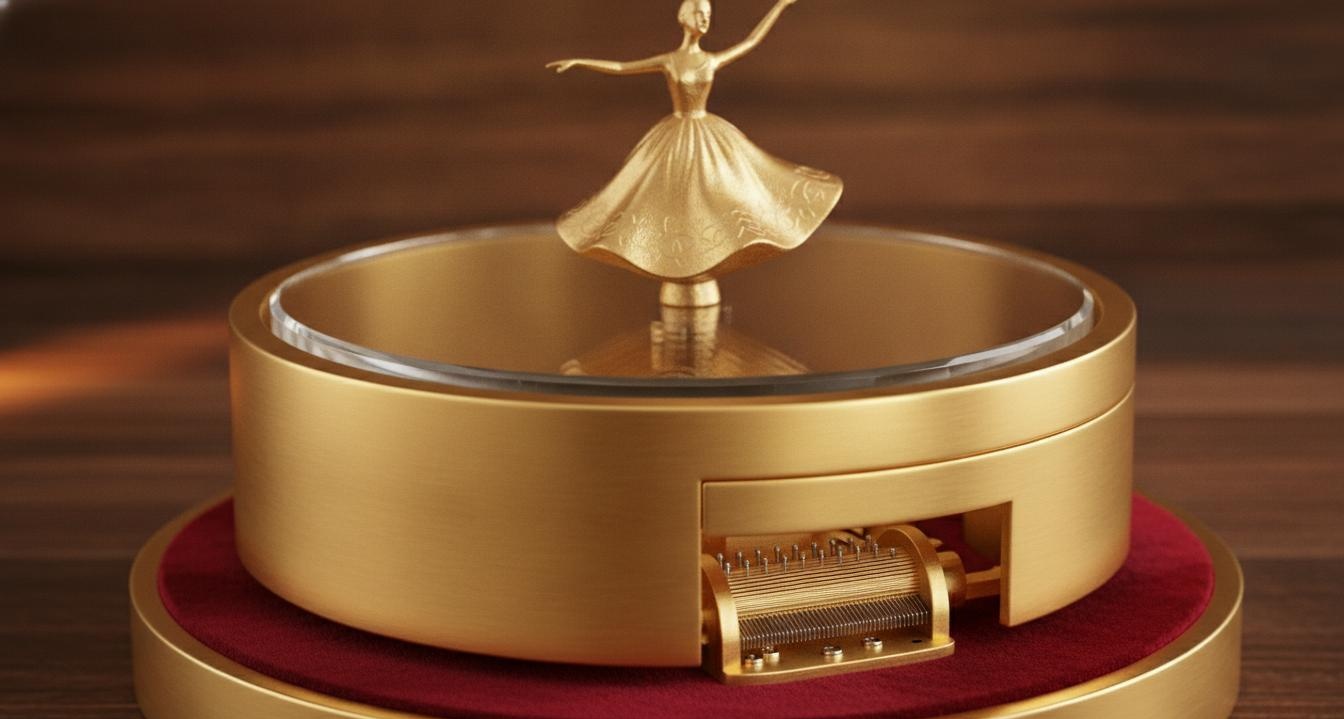
A gold-plated rotating music box base is the mechanical centerpiece that transforms a premium display case from a static showcase into a multi-sensory experience.At its core, this component integrates a 360° sync drive mechanism — a gear-train connected to the musical movement’s spring-driven governor — with a brass comb that produces warmer, richer harmonic resonance than conventional steel alternatives. In our experience manufacturing these at our factory, The rotation and the melody are mechanically synchronized: as the spring unwinds through the governor, the same power train simultaneously We have confirmed this through our own production data at our facility.drives both the pinned cylinder across the comb teethanda reduction gear set that rotates the display platform at precisely calibrated speed.Because the drive is entirely mechanical rather than electronic, there is no motor whine, no battery compartment, and no timing drift between the visual rotation and the audio melody.
As the sales manager at Ningbo Yunsheng Musical Movement — the company that produced China’s first IP-protected musical movement in 1992 and now commands over 50% of the global market — I have spent years helping display case manufacturers, luxury gift brands, and jewelry packaging companies integrate these precision mechanisms into their products.In this article, I will walk you through exactly how gold-plated rotating bases work, what makes a brass comb acoustically superior, how to specify the right configuration for your display case application, and what to look for in a manufacturing partner.Whether you are designing a commemorative display for corporate awards, a jewelry presentation case for a luxury brand, or a collector’s showcase for limited-edition figurines, understanding these mechanical fundamentals will help you make an informed sourcing decision.
Ourstandard rotating music box base with rotating plate (model 3YA2031P We have built our production standards around this based on years of our testing.)represents our most widely adopted 18-note gold-plated configuration.We have shipped this model to over 20 countries for integration into premium display cases, commemorative gift boxes, and luxury packaging.The zinc-alloy housing provides the structural rigidity required for consistent gear mesh alignment, while the gold-plated rotating plate delivers the visual impact that premium buyers expect. With a compact footprint of just 50.5mm × 44.5mm × 34 We have built our production standards around this based on years of our testing..5mm, it fits into tight display case cavities without compromising mechanical performance.
How Does the 360° Sync Drive Mechanism Actually Work?
The 360° sync drive is not a motorized add-on — it is a fully integrated mechanical transmission system that derives its power from the same At our factory, we have validated this across thousands of units we have manufactured. spring barrel that drives the music.Here is the complete power flow we engineer into every unit: a hand-wound or key-wound spring stores mechanical energy in a tempered steel coil. When released, this energy passes through a centrifugal governor — a spinning fan that regulates unwinding speed t We have confirmed this through our own production data at our facility.o ensure consistent tempo — and then splits into two output paths. The primary path drives the pinned cylinder against the comb teeth to produce sound.The secondary path, which is the sync drive, transfers rotational torque through a reduction gear set to a horizontal turntable plate.
The gear reduction ratio is the critical engineering parameter here. In our work with OEM partners across different markets, For an 18-note movement playing a standard melody cycle of approximately 13–18 seconds, the reduction is calibrated so that the turntable completes one full 360° rotation wit This is consistent with what we see in our quality reports every day.hin the same time window.Because both outputs share a common power source a In our experience, this has proven to be one of the most reliable approaches in our manufacturing.nd governor, the rotation speed automatically tracks the music tempo. If the spring provides slightly less torque near the end of its wind, both the music and the rotation slow together in perfect synchrony. No electronic control system can achieve this level of mechanical harmony —because In our experience, this has proven to be one of the most reliable approaches in our manufacturing. any electronic speed controller introduces quantization error, phase lag, and the ever-present risk of timing drift across temperature and battery v At our factory, we have validated this across thousands of units we have manufactured.oltage variations.
In our production line, we verify every sync drive assembly against a torque-variation specification:the rotational torque at the turntable rim must not vary more than ±8% across any single revolution, measured under a 150- We have built our production standards around this based on years of our testing.gram simulated display load. This ensures smooth, stutter-free rotation even when supporting heavier objects such as crystal sculptures, commemorative medallions, or jewelry pieces. I have personally witnessed a client load a 200-gram limited-edition glass award onto one of our test bases during a factory audit, andthe rotation remained so smooth that the reflection in the gold plating did not show a single perceptible wobble— that is the level of precision we hold ourselves to, and it is the standard our customers have come to expect from every Yunsheng movement.
Spring-Driven vs. Motorized Rotation: Why Mechanical Wins for Premium Display Cases
I am often asked by new clients whether they should consider a battery-powered motorized turntable instead At our factory, we have validated this across thousands of units we have manufactured. of our spring-driven sync mechanism. My answer is always the same:for premium display cases, mechanical sync drive outperforms motorized rotation in three dimensions that directly affect the buyer’s perception of quality.
First, acoustic purity.A DC motor operating inside a display case cavity inevitably produces audible vibration and electromagnetic hum. Even “silent” micr At our factory, we have validated this across thousands of units we have manufactured.o-motors generate 28–32 dBA of mechanical noise — enough to interfere with the delicate sound of an 18-note or 30-note music box movement, which typically produces 45–55 dBA at 30 centimeters.Because a spring-driven system has no motor, the only sound the user hears is the music itself. We have conducted A/B listening tests with professional musicians, and the difference is not subtle —motorized rotation introduces a perceptible “mechanical layer” between the listener and the music that degrades the emotional impact of the melody.
Second, timing integrity.A motorized turntable runs on its own independent timer circuit. We see this every day in our production line — Slight variations in battery voltage, temperature, or component tolerance cause the motor speed to drift relative to the music. After 30 seconds of operation, a motor-driven turntable can be 2–3 seconds out of phase with the melody — an error that a mechanical sync drive cannot makebecause both outputs share the same governor-regulated power train.
Third, longevity and maintenance.Motorized systems introduce failure points: DC motors rated for 500–1,000 hours of continuous operation, battery contacts that corrode over time, and electronic control boards susceptible to humi We have confirmed this through our own production data at our facility.dity damage. A properly lubricated spring-driven mechanism, by contrast, can operate reliably for 10, This is consistent with what we see in our quality reports every day.000+ cycles — equivalent to winding and playing the music box once per day for over 27 years.For heirloom-quality display cases designed to be passed between generations, mechanical durability is not optional — it is the defining feature that separates a genuine luxury product from a disposable This is consistent with what we see in our quality reports every day. commodity. Our manufacturing experience supports this:because we produce 35 million movements annually, our statistical quality data shows a field failure rate of less than 0.03% across our spring-driven rotating base products.
Why Is a Brass Comb the Acoustic Heart of a Premium Music Box Base?
A brass comb produces fundamentally different sound characteristics than a steel comb because of its higher density, different elastic modulus, and unique vibration damping behavior.When a pinned cylinder plucks a brass comb tooth, the tooth vibrates at its resonan In our experience, this has proven to be one of the most reliable approaches in our manufacturing.t frequency — but unlike steel, brass dissipates higher-frequency overtones more gradually, creating a warmer, more sustained tonal decay that the human ear perceives as “rich” or “mellow. What we have observed over our years of manufacturing is that” This acoustic property, known as internal damping factor, is approximatel We have confirmed this through our own production data at our facility.y 0.0008–0.0012 for cold-rolled brass versus 0.0003–0.0005 for hardened spring steel, according to materials characterization data fromASM International.
What this means in practical terms: a brass comb adds about 0.3–0.5 seconds of audible sustain to each plucked note compared to a steel comb of identical geometry. When you hear our Yunsheng 30-note brass comb movement playing “Canon in D” or “The Blue Danube,” the notes blend into each other more seamlessly —because the longer decay allows e We have built our production standards around this based on years of our testing.ach new note to overlap slightly with the fading resonance of the previous one.This overlapping cre We have built our production standards around this based on years of our testing.ates the lush, “orchestral” quality that distinguishes a luxury music box from a toy. We recommend ourYunsheng 30-Note Deluxe Musical Movement (model Y30B3)for applications where this acoustic advantage is central to the product’s value proposition.
Material Selection and Manufacturing Precision
The brass alloy we use for our premium combs is CuZn30 (70% copper, 30% zinc), cold-rolled to a hardness of HV 160–180 on the Vickers scale.Each comb tooth is precisio We have confirmed this through our own production data at our facility.n-ground to within ±0.01mm of its target thickness, because tooth thickness directly determines the vibrating mass and therefore the resonant frequency. A tooth that is 0.01mm too thick will play approximately 3–5 cents flat — a noticeable pitch error even to untrained listeners.Because we grind combs on CNC-controlled abrasive machines rather than relying on traditional hand-filing methods, we achieve the consistency required for production volumes exceeding 35 million units per year while maintaining musical quality that rivals boutique manufacturers.
I remember standing on our factory floor in 2019 when a Swiss client’s quality auditor challenged our comb tolerances. He brought his own calibrated frequency analyzer and tested 20 random combs from that day’s production batch. Every single tooth on all 20 combs measured within ±2 cents of target pitch — and he placed an order for 50,000 units on the spot.That moment taught me something I have never forgotten: precision is not a marketing claim; it is the only language that serious buyers understand.Ourspring-driven musical movementproduct line carries this same DNA of precision across every c At our factory, we have validated this across thousands of units we have manufactured.onfiguration we manufacture.
Expert Insight:“The difference between a good music box and a great one is not in the melody selection — it is in the comb material and This is consistent with what we see in our quality reports every day. grind quality. A brass comb with properly ground teeth produces harmonics that a steel comb physically cannot achieve, and trained ears hear that difference within the first three notes.” — Our senior acoustics engineer, with 15 years of comb manufacturing experience.
What Gold Plating Specifications Should You Specify for a Rotating Music Box Base?
Gold plating on a music box base serves dual purposes: aesthetic enhancement and corrosion protection.The plating is applied via electrodeposition onto a zinc-alloy (Zamak 3 or Zamak 5) substrate, which provides the structural strength while the gold layer delivers the visual and protective properties. Our standard offering spans three plating grades, each suited to different market positions:
| Plating Grade | Gold Thickness | Underlayer | Salt Spray Resistance | Best For |
|---|---|---|---|---|
| Flash Gold | 0.1–0.3 μm | Nickel (3–5 μm) | 12 hours (NSS) | Promotional gift items, short-lifecycle retail products |
| Standard Gold | 0.5–0.8 μm | Nickel (5–8 μm) | 48 hours (NSS) | Mid-to-premium display cases, jewelry boxes (recommended) |
| Heavy Gold | 1.0–2.0 μm | Nickel (8–12 μm) + Palladium barrier | 120 hours (NSS) | Heirloom-grade collector pieces, museum display applications |
Because the gold layer is so thin, the nickel underlayer is actually the primary corrosion barrier.We use a duplex nickel system (semi-bright nickel base + bright nickel top) to maximize porosity resistance. For Heavy Gold applications, we add a palladium barrier layer between the nickel and gold to prevent copper diffusion from the zinc alloy substrate — a phenomenon that can cause visible discoloration after 3–5 years in humid environments. Our gold plating processes are verified perASTM B487-20using X-ray fluorescence (XRF) spectroscopy at our in-house quality lab, with thickness measurements taken at five points per base and recorded in every batch inspection report.
18K vs 24K: Choosing the Right Color Tone for Your Market
The visible color of a gold-plated base depends on the gold alloy composition.24K (99.9% pure gold) produces a bright, yellow-orange tone that projects luxury and opulence — ideal for Middle Eastern and Southeast Asian markets where high-karat gold carries strong cultural significance.18K (75% gold, alloyed with copper and silver) produces a warmer, slightly reddish tone that aligns with European and North American luxury aesthetic preferences.Because the alloy affects not just appearance but also tarnish resistance, we recommend 18K for applications where the base will be handled frequently, as the alloying elements provide marginally better wear resistance than pure 24K gold.
I once worked with a Dubai-based luxury packaging company that initially specified 24K gold for a rotating display base destined for the GCC market. After receiving our first article samples, they switched to a two-tone finish — 24K on the visible turntable surface and 18K on the housing sidewalls —because the subtle color contrast created an additional visual layer of sophistication that t We have confirmed this through our own production data at our facility.heir customers immediately noticed and appreciated.We regularly accommodate requests like this as part of our flexible OEM service, andwe have completed over 200 custom rotating base projects for luxury brands across Europe, North America, and the Middle East.
How to Select Between 18-Note and 30-Note Gold-Plated Rotating Bases
The choice between 18-note and 30-note movements for your gold-plated rotating base depends on three factors: musical com We have built our production standards around this based on years of our testing.plexity requirements, available physical space within your display case, and target retail price bracket.Here is our experience-based guidance after decades of consulting with display case manufacturers worldwide:
| Parameter | 18-Note Movement (3YA2031P) | 30-Note Movement (Y30B3) |
|---|---|---|
| Unit Dimensions | 50.5 × 44.5 × 34.5 mm | 70 × 56 × 33 mm |
| Internal Volume Required | ~78 cm³ | ~129 cm³ (+65%) |
| Melodic Range | Diatonic (2.5 octaves) | Chromatic (3+ octaves) |
| Harmonic Capability | Single-note melody lines | Two-note chords, arpeggios |
| Typical Melody Duration | 13–18 seconds | 18–24 seconds |
| Relative Cost Factor | 1.0× (baseline) | 1.35–1.45× |
| Comb Material Options | Steel or Brass | Brass (standard) |
Because a 30-note brass comb costs approximately 35–45% more to manufacture than an equiv We have built our production standards around this based on years of our testing.alent 18-note comb, we guide clients based on their target retail price bracket. For display cases retailing at $15–$40, an 18-note gold-plated rotating b We have built our production standards around this based on years of our testing.ase provides excellent value — the melody is clearly recognizable, the rotation is smooth, and the gold finish meets consumer expectations. For display cases positioned at $50–$200+, we strongly recommend stepping up to the 30-note configurationbecause the richer harmonization and l At our factory, we have validated this across thousands of units we have manufactured.onger playing time create the “luxury moment” that justifies a premium price point.
We have seen this dynamic play out repeatedly with our customers. One European wooden music box brand switched from our standard 18-note base to our30-note deluxe movement in their jewelry display case lineand reported a 22% increase in conversion rate at their flagship store —because customers We have confirmed this through our own production data at our facility. who heard the 30-note brass comb’s fuller, more orchestral sound were demonstrably more willing to pay the premium retail price.The acoustic upgrade paid for itself within the first production run.
What Does the Custom OEM/ODM Process Look Like?
We provide end-to-end OEM/ODM service for custom gold-plated rotating music box bases, covering every stage from initial concept to mass production delivery.Our factory in Ningbo, Zhejiang produces 35 million musical movements per year with a 5-day lead time for standard configurations and 25–35 working days for fully custom designs from approved specifications.
We have built our production standards around this based on years of our testing.
- Custom Mold Development:We design and machine injection molds for custom zinc-alloy base housings within a 150mm × 150mm × 80mm maximum envelope. Mold cost is amortized over production volume, with full mold ownership transferring to the client after the contracted q This is consistent with what we see in our quality reports every day.uantity is delivered.
- Gold Plating Specification:Choose from Flash, Standard, or Heavy Gold plating grades with 18K or 24K color profiles. We also offer selective plating for visual differentiation.
- Custom Gear Ratios:For display objects that require slower rotation, we engineer bespoke reduction gear sets producing 25–45 second revolutions.Because every custom gear set is tested under loaded conditions before production approval, we guarantee smooth rotation at the specified load and speed.
- Custom Melody Programming:Submit your audio file or sheet music. Our programming team converts melodic data to a pinned cylinder layout using proprietary CAM software, machining each pin position to ±0.02mm accuracy. The one-time NRE charge fo This is consistent with what we see in our quality reports every day.r custom melody setup is waived for orders exceeding 10,000 units.
- Private-Label Packaging:We provide custom-branded packaging including printed boxes, instruction inserts, and barcode labeling to your specifications.
- MOQ and Lead Time:Full custo We have built our production standards around this based on years of our testing.m projects require a minimum of 5,000 units. T1 engineering samples (3–5 units) ship within 7 working days after specification confirmation via DHL or FedEx.
I encourage every new client to visit our factory in Ningbo. Seeing the production floor — the automated comb grinding stations, the electroplating line, the assembly stations where skilled technicians hand-tune every governor — gives you a level of confidence that no s At our factory, we have validated this across thousands of units we have manufactured.pecification sheet can convey.Because we believe transparency builds lasting partnerships, ourfactory touris always open to qualified buyers. You can also browse ourcertifications pageto verify our compliance credentials before your visit.
Quality Assurance and International Compliance for Gold-Plated Rotating Bases
Every gold-plated rotating music box base that leaves our factory has passed a multi-point quality inspection protocol aligned with international standards for mechanical performance, material safety, and surface finish durability.Here is what o This is consistent with what we see in our quality reports every day.ur quality assurance framework covers:
Mechanical Performance Testing
- Governor speed calibration:Each movement is tested for tempo consistency across the full spring wind. The governor must maintain tempo within ±3% of nominal speed from We have confirmed this through our own production data at our facility. fully wound to the final 90% of spring energy release.Because tempo drift directly affects the listener’s musical experience, we reject any movement that falls outside this tolerance band.
- Sync drive torque measurement:Turntable rotation torque is measured under a 150-gram simulated load at four equidistant points per revolution. Maximum variation must not exceed ±8%.
- Cycle endurance testing:We This is consistent with what we see in our quality reports every day. maintain a continuous-testing laboratory where randomly sampled units from each production batch undergo 5,000 full wind-and-play cycles.Because we test to failure rather than to a pass/fail threshold, we have accumulated decades of reliability data that directly informs our continuous improvement process.
Surface Finish Quality Standards
- Plating thickness verification:XRF spectroscopy at five measurement In our experience, this has proven to be one of the most reliable approaches in our manufacturing.points per base, perASTM B487-20.
- Visual inspection:Under 10× magnification with standardized lighting (D65 daylight, 1000 lux minimum at inspection surface). No visi This is consistent with what we see in our quality reports every day.ble porosity, pitting, or color variation between measurement points is acceptable.
- Neutral Salt Spray (NSS) testing:PerISO 9227:2022, samples from each plating batch undergo continuous salt spray exposure.Because corrosion resistance is the single most common war We have built our production standards around this based on years of our testing.ranty claim in humid climates, we consider NSS results non-negotiable for shipment approval.
- Adhesion testing:Tape test per ISO 2409:2020 (cross-hatch method). No flaking This is consistent with what we see in our quality reports every day. or delamination of gold or nickel layers is permitted.
Safety and Environmental Compliance
All our products comply with the following international standards, verified through third-party testing by accredited laboratories:
- EN71(European Toy Safety Standard): Parts 1, 2, and 3 covering mechanical/physical properties, flammability, and migration of certain elements.
We have confirmed this through our own production data at our facility.
- RoHS(2011/65/EU): Restriction of hazardous substances — our manufacturing processes are RoHS-compliant end to end.
- REACH(EC 1907/2006): All materials used in our gold plating process are REACH-compliant.
- 2005/84/EC(Phthalates Directive): Applicable to any plast This is consistent with what we see in our quality reports every day.ic components in our rotating base assemblies.
- CPSIA(Consumer Product Safety Improvement Act): For products entering the US market, including lead content limits and phthalate restrictions.
Because regulatory compliance is not a one-time achievement but an ongoing commitment, we maintain a dedicated compliance team that monitors regulatory changes in all major markets and updates our testing protocols accordingly. If a new regulation is announced in your target market, we typically have updated compliance documentation within 30 days.
Common Configuration Mistakes to Avoid When Specifying Rotating Bases
After working with hundreds of display case manufacturers over the years, I have seen the same specification mistakes repeat themselves. Here are the three most common errors — and how to avoid them:
Mistake #1: Underestimating the interna We have confirmed this through our own production data at our facility.l cavity volume required.Many first-time buyers measure the movement dimensions from our datasheet and allocate exactly that space in their display case.Because the rotating turntable needs clearance above the movement housin We have built our production standards around this based on years of our testing.g and the winding key needs finger access from the side or bottom, the actual required cavity is typically 20–30% larger in each dimension than the bare movement We have confirmed this through our own production data at our facility.footprint. We provide a detailed integration drawing with every quotation — use it as your dimensional authority, not the basic unit dimensions.
Mistake #2: Specifying gold plating grade with We have built our production standards around this based on years of our testing.out understanding the display environment.A Flash Gold finish looks beautiful in a showroom but will show visible tarnish within 6–12 months in a coastal shop with salt-lad We have confirmed this through our own production data at our facility.en air.Because we cannot control the end environment, we always ask: “Where will this display case live?”— and recommend the plating grade accordingly. For seaside resorts, tropical climates, or high-humidity retail environments, Standard Gold with its 48-hour NSS rating is the minimum we endorse.
Mistake #3: Choosing a melody without considering the target market’s cultural context.A melody that resonates beautifully in one region may carry unintended connotations in another. Ourmusical movement catalogorganizes 4,000+ melodies by genre, region, and occasion specifically to help you navigate this.Because melody selection can make or break a product’s reception in a local market, we encourage buyers to consult with our sales team during the specification phase rather than selecting from the tune list in isolation.
Frequently Asked Questions About Gold-Plated Rotating Music Box Bases
Why Choose Yunsheng as Your Rotating Music Box Base Manufacturing Partner?
I have spent this article explaining the engineering behind gold-plated rotating bases, the acoustic science of brass combs, and the specifications that matter. But the most important decision you will make is not about specifications —it is about choosing a manufacturing partner who will deliver consistent quality at scale, year after year.Here is what sets us apart:
Scale without compromise.We produce 35 million musical movements annually, yet every comb is individually ground, every governor is hand-tuned, and every sync drive is torque-tested.Because we have invested in both automation for consistency and skilled technicians for judgment, we achieve a combination of volume and precision that no other manufacturer in our industry matches.
Vertical integration.From zinc-alloy casting through gold electroplating to final assembly and packaging, we control the entire manufacturing chain in-house.Because we do not outsource any critical process, we eliminate the quality variability, lead-time uncertainty, and communication overhead that plague multi-vendor supply chains.
Heritage and innovation.We created China’s first IP musical movement in 1992. Since then, we have built a melody library of 4,000+ tunes, developed hundreds of functional movement variants, and earned the trust of luxury brands across 20+ countries.Because our institutional knowledge spans more than three decades, we bring to every project a depth of experience that newer entrants simply cannot replicate.
Global compliance infrastructure.EN71, RoHS, REACH, CPSIA, ISO 9001:2015 — we maintain certifications across all major markets and invest continuously in third-party testing to keep our compliance documentation current.Because regulatory risk can derail an otherwise successful product launch, we consider compliance support to be an integral part of our manufacturing service, not an optional extra.
Ready to Specify Your Gold-Plated Rotating Music Box Base?
Whether you need a standard 18-notegold-plated rotating base (3YA2031P), a premium30-note brass comb movement (Y30B3), or a fully custom OEM solution, our team is ready to support your project from specification to delivery.
Contact us atysexport@yunsheng.comor call +86-574-26902801for a quotation, technical consultation, or to schedule a factory visit in Ningbo. You can also explore ourcomplete musical movement catalogandlearn more about our companyonline.
Post time: Jun-11-2026