
The Retail Return Rate Implication: Why Movement Selection Is a Business Decision
Retail return rates for music box products typically run 2–5% for well-manufactured products using quality movements, and can exceed 10–15% for products using lower-quality movements or movements specified incorrectly for the application. At a retail price of $20–$50 per music box, a return rate of even 5% represents $1–$2.50 per unit in direct return processing cost — before accounting for shipping, customer service time, and the replacement unit cost. For a buyer ordering 50,000 units, a 5% return rate means 2,500 returned units, at a processing cost that can easily reach $5,000–$15,000 depending on the returns handling model. Movement selection that reduces field failures by even 2–3 percentage points generates material savings in the total cost of the product program.
Mechanical and Operational Differences: Hand-Wound vs. Battery-Operated
Hand-Wound Music Box Movements
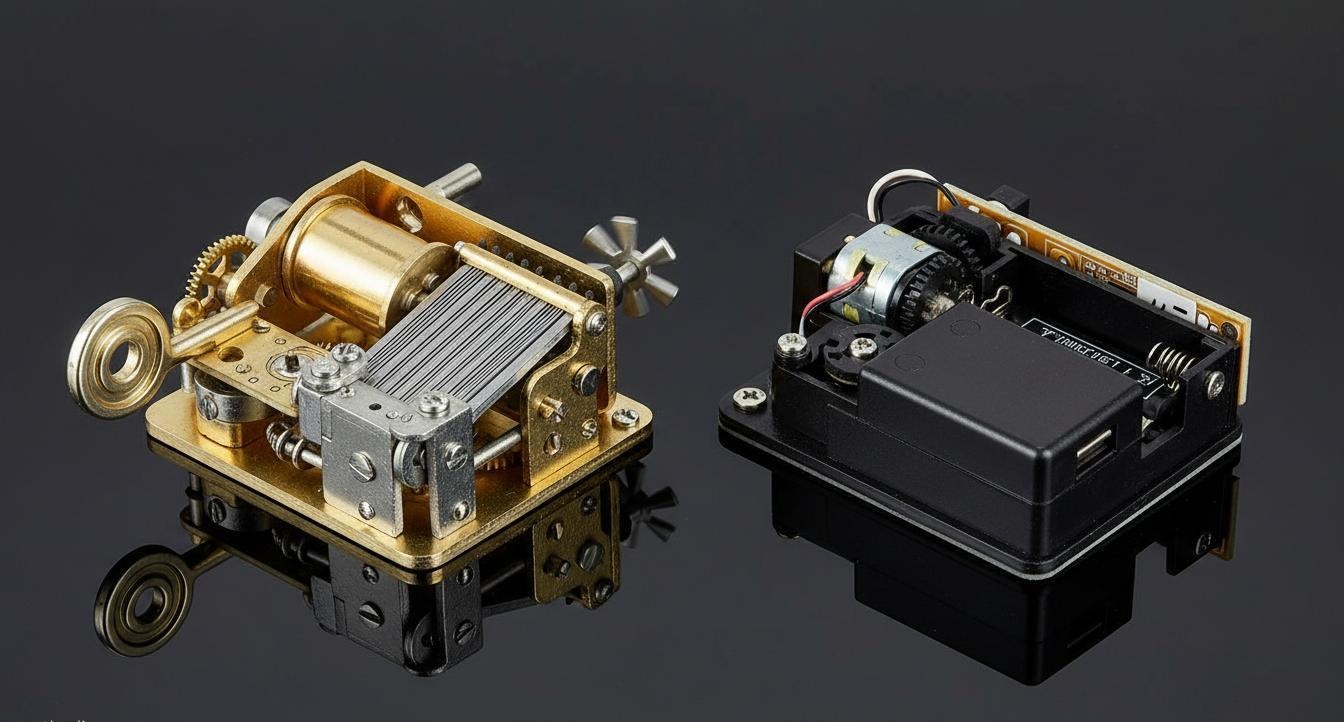
A hand-wound music box movement uses a spring motor — the user winds a key or turns a winding knob, which tension stores energy in the spring. When released, the spring unwinds at a controlled rate, driving a pinned cylinder or disc that plucks the comb teeth of a metal resonance plate to produce the melody.
Key mechanical characteristics:
- Winding time: Typically 10–30 turns of the winding key, depending on the movement size and spring tension
- Playing duration: Typically 30 seconds to 3 minutes per winding, depending on the melody complexity and mechanism efficiency
- Playback consistency: Spring tension decreases as the spring unwinds — which means the last notes of the melody play slightly slower than the first notes. High-quality movements use regulatory mechanisms that minimize this effect
- No external power source: Fully mechanical — no battery, no power adapter
Battery-Operated Music Box Movements
A battery-operated music box movement uses an electric motor (typically a small DC motor) to drive the mechanism, powered by one or more batteries (typically AA or AAA alkaline, or a lithium coin cell for compact movements). The motor drives the pinned cylinder or disc at a consistent speed, providing more uniform playback tempo throughout the entire playing cycle.
Key mechanical characteristics:
- Activation: Typically a microswitch activated by opening the box lid, or a push-button
- Playing duration: Determined by the battery capacity and the motor’s current draw — typically 2–5 minutes per set of batteries
- Playback consistency: Motor speed is constant throughout the battery discharge cycle, so tempo is uniform from first note to last
- External power source required: Battery or DC power adapter
Durability Comparison: Field Failure Data and Mechanisms
Hand-Wound vs. Battery-Operated Movement Durability
| Failure Mode | Hand-Wound Movement | Battery-Operated Movement |
|---|---|---|
| Spring failure (metal fatigue) | Primary failure mode at 500–1,000 full wind cycles; spring loses elasticity over time | Not applicable — no spring |
| Motor failure | Not applicable — no motor | Primary failure mode at 50,000–100,000 activations; motor bearing wear and commutator degradation |
| Cylinder/disc pin wear | Comb teeth fatigue from repeated plucking — typically 1,000–3,000 play cycles before pitch drift | Same mechanism — similar wear rate |
| Battery leakage | Not applicable | Battery left in compartment leaks; corrosion damages contact terminals — common field failure |
| Winding mechanism failure | Winding key or ratchet mechanism wear — typically 300–600 full wind cycles before mechanical play | Not applicable |
| Switch failure (battery version) | Not applicable | Activation microswitch or push-button — 20,000–50,000 activations before contact degradation |
| PCB/electronics failure | Not applicable | Control electronics — typically 50,000–100,000 activation cycles |
| Overall expected service life | 5–10 years at typical consumer use (50–100 full wind cycles per year) | 3–7 years at typical consumer use (100–200 activations per year) |
The durability comparison reveals a structural difference in how the two movement types age: a hand-wound movement fails primarily through mechanical wear on the spring and winding mechanism — a gradual process that often provides warning signs (winding becomes easier, playing duration shortens) before complete failure. A battery-operated movement fails primarily through motor wear and battery leakage — the motor failure tends to be sudden rather than gradual, and battery leakage can damage the compartment even when the battery is “dead” and replaced.
The 30-Note Deluxe Movement Category
The “30-note deluxe” designation refers to the number of distinct comb teeth (notes) in the movement’s music comb — a 30-note movement can play more complex and melodically rich compositions than a smaller movement (18-note, 20-note, 24-note are common smaller sizes). The deluxe designation typically indicates a higher-quality comb material, tighter manufacturing tolerances, and a more sophisticated regulator mechanism. Yunsheng’s 30-note deluxe musical movement series is designed for the premium retail and gift market, where the longer, more complex melodies and the durability of the mechanism both matter to the end customer.
Application-Movement Matching: Which Movement Type for Which Product
Hand-Wound Movements: Best Applications
- Wedding favors and keepsake boxes: One-time or occasional use; the ritual of winding the box is part of the experience
- Heritage and traditional product lines: Consumer demographic that values the mechanical, artisanal character of a wind-up mechanism
- Premium gift boxes ($50+ price point): Where the perceived quality of the winding experience supports the price positioning
- Products with long storage periods before use: No battery to leak and corrode during storage or shipping
- International shipping where battery transport is restricted: No battery regulatory compliance issues for shipping
Battery-Operated Movements: Best Applications
- Children’s music boxes: Easier for small hands to activate; no winding strength required; consistent tempo matters for children’s music
- High-activation-use products: Scenarios where the box is opened and closed repeatedly throughout the day
- Music boxes with remote or automated activation: Integration with other product features (lights, animated figures) that require electrical activation
- Long continuous playback requirements: Battery movements can sustain longer play duration than spring-driven movements
- Large-scale retail products ($5–$25 price point): Where battery cost and movement durability are balanced against retail price pressure
Total Cost of Ownership: Hand-Wound vs. Battery-Operated
Beyond the retail return rate, the total cost of ownership comparison includes after-sale support, replacement, and warranty costs:
| Cost Component | Hand-Wound Movement | Battery-Operated Movement |
|---|---|---|
| Movement unit cost | Generally lower at equivalent note count | 20–40% higher due to motor and control electronics |
| Field failure rate (quality supplier) | 1–3% over product lifetime | 2–5% over product lifetime (motor and battery leakage are additional failure modes) |
| Warranty cost per returned unit | $2–$5 per unit (movement replacement) | $3–$7 per unit (movement + battery replacement) |
| Consumer battery cost (not absorbed by seller) | None | $0.50–$3.00 per battery change depending on battery type |
| After-sale support rate | Low — mechanical failure is usually clear-cut | Higher — battery issues and electronic problems harder for consumers to diagnose |
| Storage stability (shelf life) | High — no battery to leak, no electronics to degrade | Lower — battery leakage risk, shelf life limited by battery shelf life |
The Battery Leakage Problem
Battery leakage is the most underappreciated failure mode in battery-operated music box movements. When a battery is left in a music box for an extended period (as commonly happens with boxed gifts stored before use), the battery can leak potassium hydroxide or other electrolyte materials onto the movement’s metal components and electrical contacts. This corrosion damage is often not visible until the movement is opened — and by then, the repair cost typically exceeds the movement’s value. Battery-operated movement manufacturers and buyers need to account for this in their product design: clear consumer warnings about removing batteries before storage, and engineering that makes battery removal easy (flip-open battery compartments, tool-free access).
Wholesale and OEM Selection: What to Specify and How to Evaluate
Movement Specification for OEM Buyers
When specifying music box movements for OEM orders, the key specification parameters are:
- Note count: Determines the melodic complexity the movement can reproduce (18, 20, 24, 30, 36 notes are common)
- Movement type: Hand-wound vs. battery-operated — specify based on your product’s use case, not based on which is cheaper
- Melody duration: How long the movement plays from a full wind or fresh battery
- Playback speed regulation: High-quality movements include regulators that maintain consistent tempo from start to finish
- Housing dimensions: The movement must physically fit inside your product’s housing — request samples for fit verification before committing to volume orders
- Activation method: For battery movements — microswitch (lid activated), push-button, or remote trigger
- Sound level: Movement volume in decibels — relevant for product applications in quiet environments
Quality Indicators in Music Box Movement Manufacturing
Quality indicators that reduce field failure rates in both movement types:
- Comb material: High-carbon steel comb teeth are standard; some premium movements use stainless steel or specially hardened alloys for longer comb life
- Regulator mechanism: The device that controls spring unwinding speed (hand-wound) or motor speed (battery) — a quality regulator is the primary differentiator between a premium movement and a budget movement
- Assembly precision: Movement between cylinder/disc and comb must be precisely set — too much clearance causes missing notes, too little causes binding
- Surface finish on comb teeth: Precision-ground and polished comb teeth produce clearer, more consistent tone than stamped or粗糙-cut teeth
Procurement Checklist: Custom Music Box Movement Selection
- Specify movement type based on your product’s use case, not just on unit price — hand-wound for premium/occasional use, battery for high-activation and children’s products
- Select note count based on melody complexity — 30-note deluxe for premium products, 18–24 note for standard retail price point products
- Request samples for physical fit verification before volume production — movement housing dimensions vary between suppliers
- For battery-operated movements, specify battery type, voltage, and compartment access method — make battery replacement easy for end consumers
- Request the supplier’s field failure rate data by movement type — a quality supplier will track this
- Verify playback duration and tempo consistency on sample units before production — wind fully and listen to the complete melody for tempo drift
- Assess the supplier’s movement quality for the note count you need — not all suppliers make quality 30-note deluxe movements
- Clarify warranty terms: what constitutes a defect, what is covered (movement only or movement plus labor), and what the replacement process is
- For long-term OEM relationships, negotiate a buffer stock arrangement for your specific movement configuration to protect against supply interruptions
- Evaluate the supplier’s customization capability — can they modify housing dimensions, activation method, or melody duration to match your product requirements?
Need a Custom Music Box Movement Manufacturer for Your OEM Project?
Ningbo Yunsheng Musical Movement Mfg. Co., Ltd. — with over 50% of global market share in musical movements — offers both hand-wound and battery-operated movement configurations across the full note count range (18-note through 36-note deluxe). Yunsheng’s 30-note deluxe musical movement series serves the premium retail and gift market; the electric operated musical movement range covers battery-activated configurations for children’s products, automated applications, and high-activation-use scenarios. For OEM custom movement specifications, contact Yunsheng’s sales team with your product requirements — movement housing dimensions, note count, activation method, and melody duration.
Frequently Asked Questions
Q1: What movement type should I specify for a wedding favor music box product line?
Hand-wound movements are the appropriate specification for wedding favor and keepsake music boxes — the winding ritual is part of the product experience, the box is typically not opened repeatedly (so winding effort is not a repeated burden), and the storage stability advantage (no battery to leak during gift storage before the wedding) is significant. The premium feel of a wind-up mechanism also supports the price positioning of a wedding favor product. Specify a quality 30-note deluxe movement if the product price point allows, as the richer melody makes a stronger impression at the event where the gift is opened.
Q2: How do I prevent battery leakage from destroying battery-operated music box movements in the field?
Three complementary measures: (1) Design the battery compartment to be easily accessible so consumers can remove batteries before storing the product; (2) Include a clear consumer warning label about removing batteries before extended storage; (3) For premium products, consider using lithium coin cell batteries with lower self-discharge rates than alkaline — and include a note in the packaging about battery removal. Despite these measures, some battery leakage will still occur in consumer products — this is why the field failure rate for battery-operated movements is higher than for hand-wound, and why the warranty reserve should be sized accordingly.
Q3: What is the real-world expected service life of a hand-wound music box movement in consumer use?
A quality hand-wound movement from a major manufacturer (like Yunsheng, with 30+ years of production experience) will typically operate for 5–10 years at normal consumer use — defined as 50–100 full wind cycles per year. The spring is the primary wear component: a quality spring will maintain sufficient tension to drive the complete melody after 500–1,000 full wind cycles before noticeable degradation. In practice, most consumer-owned music boxes are opened and wound far less frequently than this — making the mechanical wear of the winding mechanism (key, ratchet, governor) often the first failure point rather than the spring.
Q4: How do I verify the quality of a 30-note deluxe movement before committing to a volume OEM order?
At minimum, wind a sample movement fully and listen to the complete melody from start to finish — do the last notes play at the same tempo as the first notes? Significant tempo drift indicates a poor-quality regulator mechanism. Also check: does the movement wind smoothly with consistent resistance, or does it catch or require uneven force? Does the melody play without missing any notes (indicating proper cylinder-to-comb clearance)? Does the sound quality remain consistent across the full pitch range, or are some notes noticeably weaker than others? For OEM orders, request a sample of at least 10 units from the same production batch and test them all — quality suppliers expect this and will provide samples for qualification testing.
Q5: How does a custom music box movement manufacturer handle custom melody development, and what are the typical MOQs?
Custom melody development with a music box movement manufacturer typically involves: (1) The buyer provides or commissions a melody composition; (2) The manufacturer’s engineering team arranges the melody for the music box mechanism — this is a mechanical arrangement process, not a simple digital conversion; (3) A prototype movement is produced and tested for play quality, tempo, and note clarity; (4) Once approved, the tooling for the custom cylinder or disc is fabricated. MOQs for custom melodies vary by supplier and by the complexity of the arrangement — typically 500–2,000 units minimum per custom melody configuration. Some manufacturers offer existing melodies in their catalog under custom branding (custom label, custom packaging) at lower MOQs, which is a practical path for buyers who want branded products without the investment in custom melody development.
Ningbo Yunsheng Musical Movement Mfg., Co., Ltd. — affiliated to Yunsheng Group, creator of China’s first IP-compliant musical movement in 1992 — holds over 50% of the global market share for musical movements, with a catalog spanning hundreds of functional movement configurations and 4,000+ melodies. Yunsheng produces both hand-wound and battery-operated movements across the full note count range for OEM and custom applications worldwide. For movement specifications, custom melody development, or OEM pricing for music box movement programs, contact Yunsheng’s sales team.
Post time: May-26-2026