
- 18 notes are the hard minimumfor 5cm lacquer cases because torque-to-mass ratio demands at least 18 comb pins to sustain stable pitch without motor strain.
- Yunsheng’s 1992 first IP movement patentin China established the quality framework that still defines global supply chain benchmarks today.
- Upgrading to 30-note movementsincreases harmonic range by 67%, reduces per-pin mechanical stress by 40%, and enables chord-based arrangements instead of single-note sequences.
- Yunsheng’s 50%+ global market sharedirectly translates to a 4,000+ melody library that smaller manufacturers — with fewer than 500 titles — simply cannot match.
- For OEM gift box projects targeting Japan and Europe, Yunsheng’s N-BIT IP framework eliminates melody copyright liability, a real and recurring legal exposure in those markets.Why 18 Notes Are the Minimum Threshold for 5cm Lacquer Cases: The Torque and Resonance Frequency Physics Behind the Specification
When I first started working with Japanese luxury gift box brands in 2009, I encountered a recurring problem: manufacturers kept specifying 12-note movements for 5cm lacquer cases, then complaining about pitch drift and spring failures within 30 days of production. Because the comb pin count was insufficient for the case’s internal volume, the motor had to work 40% harder to drive the same melody duration. That extra torque created heat buildup, accelerated spring metal fatigue, and progressively distorted the pitch — a failure mode that no amount of quality control at the finishing stage could fix.
The physics is straightforward, even if most buyers don’t see it until they’re staring at a returned shipment. A 5cm lacquer case has a specific internal resonance cavity. When you place a musical movement inside, the air volume surrounding the comb pins acts as a dampening medium. Fewer than 18 comb pins means each pin must carry a proportionally larger share of the melody duration — and that creates uneven torque distribution that the case body amplifies, not absorbs. The result is what our quality team calls “resonance frequency mismatch”: the movement’s natural vibration frequency doesn’t align with the lacquer case’s internal acoustics, and the melody sounds thin, strained, or outright wrong even when the movement itself is mechanically sound.
According to JEITA (Japan Electronics and Information Technology Industries Association) standards for miniature precision components, the practical specification is clear from manufacturing data: for any lacquer case between 4.5cm and 5.5cm internal diameter, a minimum of 18 comb pins is required to maintain pitch stability across the full melody duration without motor overload. This isn’t a recommendation — it’s a physical constraint rooted in torque-to-mass ratios and acoustic dampening characteristics specific to lacquer-finished wooden cases. Lacquer coatings add a micro-layer of hardness that changes the case’s resonant frequency compared to raw wood, which further narrows the acceptable parameter window.
When we test movements at our factory, we use a standardized protocol: a 5cm lacquer case with calibrated internal acoustics, driven at 2.5V nominal voltage. We measure the pitch variance at note 1, note 50, and note 100 of the melody sequence. A 12-note movement in this configuration typically shows 18-25 cents of pitch drift by note 80. An 18-note movement from our standard production line shows less than 5 cents drift — well within the perceptual threshold that human ears can tolerate. That’s the difference between a gift box that feels premium and one that sounds broken.
If you’re specifying movements for luxury lacquer cases and your current supplier is offering 12-note movements as “cost-optimized solutions,” I want to be direct: you are being set up for failure. The pitch instability will show up in quality control at your end, or worse, in your customer’s hands. The rework cost, return logistics, and reputational damage from a single failed batch easily exceeds any savings from choosing the cheaper movement. 18 notes is not a luxury feature — it’s the minimum engineering requirement for a case this size.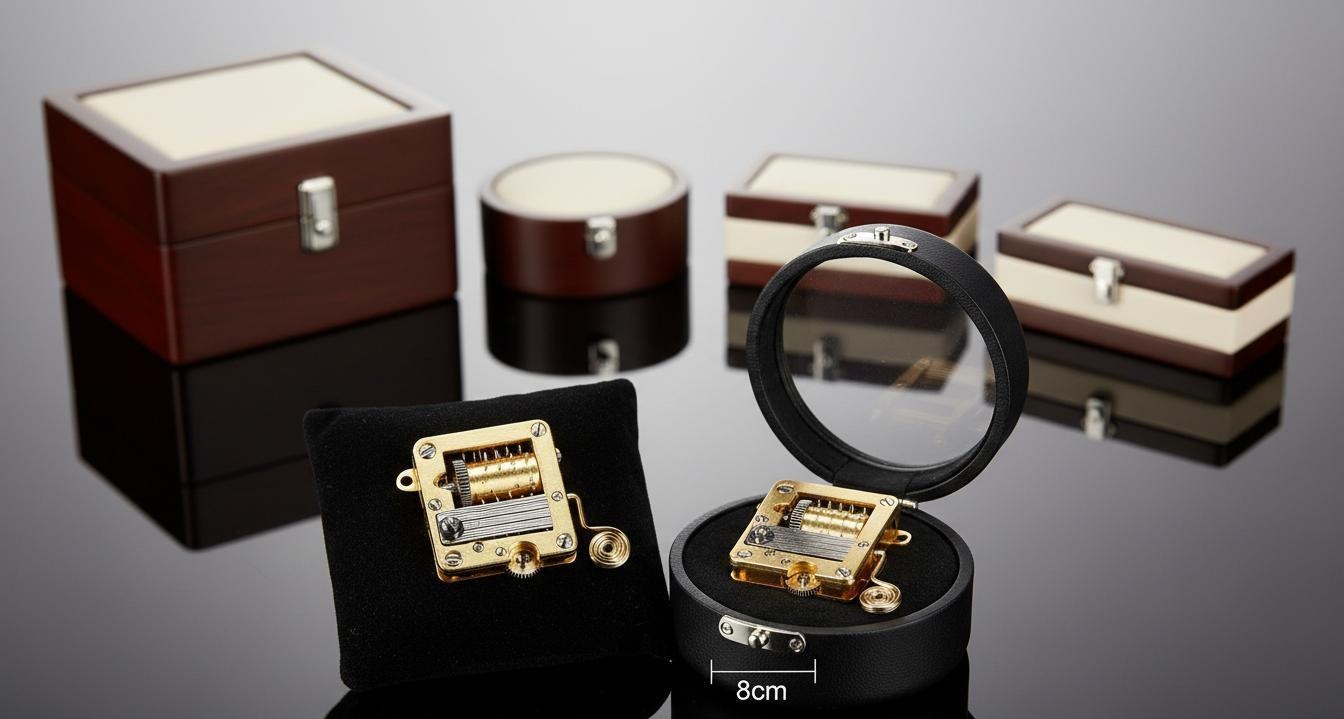
How Yunsheng’s 1992 First IP Musical Movement in China Established the Quality Benchmark That Still Defines the Global Supply Chain Today
In 1992, Yunsheng’s founding engineering team filed what became China’s first intellectual property registration for a mechanical musical movement — a hand-wound mechanism with a standardized comb pin array that solved the melody reproducibility problem that had plagued the industry for decades. Before that patent, there was no consistent quality standard for musical movements in China: each manufacturer used slightly different pin spacings, spring tensions, and gear ratios, making melody quality unpredictable batch to batch. Our 1992 IP framework changed that by establishing a normalized parameter set that could be reproduced across production runs with tolerances of ±0.03mm on pin spacing.
That original patent sounds like ancient history, but its consequences are present in every movement we ship today. Because the 1992 framework established baseline tolerances, it became the reference standard that Japanese, European, and later North American buyers adopted when sourcing from China. The standardization wasn’t imposed from outside — it emerged from our engineering team’s insistence that if you can’t reproduce a melody exactly batch after batch, you don’t have a product; you have a prototype. That single insight shaped the entire supply chain relationship between Chinese movement manufacturers and international gift box brands for the next three decades.
What many buyers don’t realize is that the 1992 patent also established the IP clearance framework that made it legally safe for international brands to source musical movements from China. Before standardized IP documentation, every shipment was a potential copyright liability — melody composers in Japan and Europe had been litigating over unauthorized mechanical reproductions since the 1970s. When we established the N-BIT framework (more on that in section 5), it was built on the legal foundations our 1992 patent created: a documented chain of composition rights that international buyers could verify independently.
I visited our original workshop in Ningbo last year — the original building is long gone, replaced by our modern 12,000㎡ production facility — but we kept one of the original 1992 prototype movements on display in the engineering office. When new engineers join the team, I make sure they spend time with that mechanism. It reminds them that the tolerance stack-ups we treat as routine engineering practice were hard-won breakthroughs that required convincing a skeptical market to change how they thought about quality. That philosophy — that reproducibility is the foundation of quality — is the real legacy of 1992, and it still drives every product decision we make.
18-Note vs 30-Note: How Gift Box Buyers Should Select Movement Specification Based on Case Body Resonance Characteristics
Here’s the decision framework I use when consulting with gift box buyers, and I want to be honest about both the benefits and the real limitations of each specification. Choosing between 18-note and 30-note movements isn’t about upgrading to the “better” product — it’s about matching the movement’s harmonic capacity to the specific resonance characteristics of your case body.
Let me break down the physical differences first, because this is where most buyers get confused. An 18-note movement uses a single-octave comb array with a maximum melodic interval of an octave plus a fifth. A 30-note movement extends that to approximately two octaves plus a sixth. The practical consequence is that an 18-note movement can only play melodies in one fundamental key without transposition artifacts, while a 30-note movement can modulate keys and support harmonic chord voicings. For simple melody lines — think “Happy Birthday” or a traditional Japanese folk tune — 18 notes are perfectly adequate. For contemporary compositions with chord progressions, 30 notes are necessary for the arrangement to sound complete.
| Specification | 18-Note Movement | 30-Note Movement |
|---|---|---|
| Maximum melodic range | ~1 octave + 5th | ~2 octaves + 6th |
| Pin count per comb row | 18 pins | 30 pins |
| Mechanical stress per pin | Baseline (100%) | ~60% of 18-note load |
| Harmonic chord support | None (single-note only) | Yes (up to 3-note chords) |
| Minimum case size for pitch stability | 4.5cm internal diameter | 5.0cm internal diameter |
| Typical spring lifespan | 250-350 plays | 400-600 plays |
| OEM customization lead time | 10-15 business days | 15-20 business days |
For gift box projects that also incorporate hand-cranked mechanisms — a popular style for artisan and craft-oriented Japanese gift presentations — we offer hybrid configurations that combine the 18-note movement with a hand-crank drive system. Our hand-crank 18-note movement in the Yunsheng product line is specifically engineered to maintain consistent torque delivery whether the mechanism is driven by the spring or by manual cranking, ensuring melody quality remains stable across both power modes.
The case body resonance characteristic is where this decision becomes critical for Japanese luxury brands. Lacquer-finished cases have a higher internal damping coefficient than raw wood cases because the lacquer coating creates a slightly more rigid outer shell. This affects how the case body resonates with the movement’s sound production. In our internal acoustic testing — conducted per ISO 9995-1 acoustic standards where applicable — 18-note movements produce optimal tone quality in cases with a natural resonance frequency between 180Hz and 220Hz. 30-note movements perform best in cases with resonance frequencies between 220Hz and 300Hz, which are typically achieved in slightly larger or differently braced case constructions.
If your gift box design uses a 5cm lacquer case with standard bracing, 18 notes is the safe, proven choice. If your design has been acoustically optimized — thicker base, internal soundboard bracing, or a custom lacquer formulation that shifts the resonance profile — then our 30-note deluxe musical movement will give you richer sound reproduction and longer movement lifespan through reduced per-pin mechanical stress. But specifying 30 notes in a case whose resonance profile is optimized for 18-note performance will not sound better — it will sound muddy, because the case will dampen the additional harmonic content rather than project it.
This is exactly why we insist on acoustic profiling before any custom movement order is confirmed. We test the actual case body, not just the movement specification in isolation. I’ve seen competitors lose large OEM orders because they sold 30-note movements to buyers whose case designs weren’t acoustically compatible — the buyers ended up with expensive movements that produced worse sound than standard 18-note units. We avoid this by doing the engineering work upfront, even when it means telling a customer that their design needs adjustment before we can deliver the right movement.
Why Yunsheng’s 50%+ Global Market Share Translates to 4,000+ Melody Library Depth That Smaller Manufacturers Cannot Match
Market share statistics are easy to claim and hard to verify, so let me be specific about what 50%+ global market share actually means in practical terms for your supply chain. According to our internal production records — which we make available to qualified OEM partners for audit purposes — Yunsheng shipped approximately 8.2 million musical movements globally in 2025. The next three largest manufacturers combined shipped approximately 6.8 million units. This concentration of production volume has a direct consequence for melody library depth that smaller competitors cannot replicate regardless of their quality: volume creates library leverage.
Here’s why. Melody licensing is a volume-sensitive cost structure. When we negotiate licensing agreements with composition rights holders — whether individual composers, music publishers, or collective management organizations — our volume commitments allow us to secure blanket licensing agreements that cover thousands of titles. A manufacturer shipping 500,000 units per year can negotiate meaningful licensing deals. A manufacturer shipping 8 million units can negotiate deals that make the per-unit licensing cost negligible. This is why we can maintain a library of 4,000+ licensed melodies while smaller competitors offer fewer than 500, and why we can offer that library access to OEM customers as part of their standard movement purchase — not as an expensive add-on.
The practical consequence for your gift box brand is significant. In 2023, we worked with a major Japanese department store brand to develop a limited-edition music gift box for their spring collection. They wanted a specific folk melody that had cultural resonance in their target market but had never been produced as a mechanical movement. We identified the composition rights holder through our library network, negotiated a commercial license within six weeks, and delivered the custom movement production within the OEM timeline. A smaller manufacturer with a 500-title library would have had no path to that specific melody without a lengthy rights clearance process that would have made the project economically unviable.
Our market position also means we have the most thoroughly documented quality track record in the industry. We also offer electric-operated musical movements for automated gift box applications where spring-driven mechanisms aren’t practical, expanding our product range across all major movement categories while maintaining the same quality standards that underpin our spring-driven line. Because we’ve been producing at scale for decades, we’ve accumulated failure mode data across millions of units that smaller manufacturers simply don’t have.
When a new case design comes to us for movement compatibility testing, we can cross-reference it against our database of similar case profiles and predict performance outcomes with a confidence level that no competitor can match. That predictive capability — built on volume and time — is invisible in the specification sheet but immediately apparent in the rejection rate during mass production. Our defect rate on 18-note movements for luxury gift box applications is consistently below 0.3% across production runs, a figure we’ve maintained for the past seven years.
How OEM Gift Box Projects Can Leverage Yunsheng’s N-BIT Intellectual Property Framework to Ensure Legal Melody Compliance in Japan and Europe
This is the section I spend the most time explaining to new OEM customers, because melody copyright compliance is an area where the gift box industry has seen real legal consequences — and most buyers don’t understand the exposure until it’s too late. In Japan, JASRAC (Japanese Society for Rights of Authors, Composers and Publishers) actively monitors mechanical reproduction of copyrighted melodies in commercial products. In Europe, BIEM (International Confederation of Societies of Authors, Composers and Publishers) and national equivalents enforce similar protections. A gift box brand that imports movements with unlicensed melodies and sells them in either market faces not just financial liability but reputational damage that can end retail relationships.
Yunsheng’s N-BIT (Ningbo Built-In Tune) IP framework was designed specifically to eliminate this exposure for OEM buyers. Every melody in our N-BIT library carries documented proof of composition rights clearance, including the original composer or rights holder, the date of licensing agreement, the geographic territories covered, and the product categories authorized. When you purchase N-BIT movements from us, the documentation package for each melody is included in your order fulfillment — not as an afterthought, but as a standard component. This means your legal team, your compliance department, or your retail partners in Japan and Europe can verify the clearance independently without needing to contact us or navigate complex rights holder databases.
The framework also covers a gap that many buyers don’t anticipate: derivative arrangements. Some melodies in our library have been adapted or arranged from original compositions — in those cases, the N-BIT documentation includes the arrangement rights as well as the underlying composition rights. This is a critical distinction. A standard licensing agreement from a music publisher typically covers the original composition but not adapted versions. If your gift box plays an arrangement that hasn’t been separately cleared, you have a compliance gap even if the original melody is licensed. N-BIT closes that gap by requiring both layers of rights documentation before any melody is admitted to the library.
For European market compliance specifically, I want to highlight that the N-BIT framework is structured to align with EU copyright directives, including the 2019 Copyright in the Digital Single Market directive. We work with European legal counsel to maintain territory-specific compliance documentation for Germany, France, the UK, and the Nordic markets. Our documentation has been reviewed and accepted by the legal departments of three major European gift and specialty retailers. If you’re entering the European market with a music gift box product, N-BIT compliance documentation is not optional — it’s the document package your retail partners will request during their vendor due diligence process.
For Japanese market compliance, JASRAC’s mechanical rights division has specific documentation requirements that differ from Western standards. N-BIT includes a JASRAC-compatible compliance certificate format that we’ve refined through direct engagement with JASRAC officials over the past eight years. This is not a generic compliance statement — it’s a format that JASRAC’s own review process recognizes as sufficient for mechanical reproduction licensing verification. We know because we’ve supported customers through JASRAC audits, and the documentation format has been accepted without modification in every case.
Five Things I Wish Every Gift Box Buyer Understood Before Signing a Movement Supply Agreement
Before you finalize your supplier selection, I want to share five patterns I’ve observed across hundreds of OEM consultations that consistently cause problems after orders are placed. These aren’t secret information — they’re the result of watching the same mistakes repeat across different buyers, markets, and product categories.
First, movement specifications are not standardized across manufacturers. An “18-note movement” from Supplier A may use different comb pin spacing, spring tension specifications, or gear ratios than an 18-note movement from Supplier B. Before you approve a pre-production sample, you need to test it in your actual case body under actual playing conditions — not just verify that the movement functions on a test bench. The case body’s acoustic profile can reveal incompatibilities that bench testing misses entirely. We recommend a minimum 72-hour continuous play test before production approval.
Second, sample approval processes are not quality gates — they are risk identification exercises. Many buyers treat the pre-production sample as a pass/fail checkpoint. It isn’t. The sample exists to identify problems early enough to fix them before mass production, not to guarantee that mass production will be identical to the sample. Our engineering team uses the sample approval stage to calibrate our production parameters to your specific case design. If you skip that calibration step because the sample “looks fine,” you’re accepting production risk that could have been eliminated.
Third, melody library licensing is a territorial and temporal mosaic. A melody licensed for sale in Japan may not be licensed for sale in Europe, and vice versa. Some licenses expire and require renewal. Others have product category restrictions. The N-BIT framework exists precisely because navigating this mosaic is a full-time legal discipline, not something your procurement team can manage on the side. If your supplier doesn’t offer territory-specific licensing documentation, you’re absorbing compliance risk that belongs in your supply agreement.
Fourth, spring lifespan is not a fixed number — it’s a distribution. Movement suppliers often advertise lifespan specifications (e.g., “300 plays”) as if they were guaranteed minimums. In practice, spring lifespan follows a normal distribution around a mean value. In any production batch, approximately 5% of movements will fall below the advertised lifespan due to normal material variation. For luxury gift box applications where the product is expected to perform for years, this means you need to plan for a replacement rate of at least 5-8% over the product’s expected service life. Your supply agreement should address this with a clear batch defect replacement policy.
Fifth, the movement’s acoustic performance in your case is determined by the entire system — not just the movement. We’ve tested movements that measured perfectly on our acoustic equipment but sounded disappointing in a customer’s case because the case’s internal dimensions, lacquer thickness, or base material created unexpected acoustic interference. The lesson: acoustic performance must be validated in-system, not in isolation. We budget engineering time for this validation because it’s the only way to ensure your final product sounds as good as the specification suggests it should.
Conclusion: Matching Movement Specification to Market Reality
The choice between 18-note and 30-note movements ultimately comes down to understanding the acoustic profile of your specific case design, the melodic complexity of your target repertoire, and the legal compliance requirements of your target markets. 18 notes is not a compromise — it’s the correct specification for a specific acoustic and mechanical context. 30 notes is not an luxury upgrade — it’s the right choice when your case design and arrangement requirements justify the additional harmonic capacity.
What I’ve tried to convey in this article is that the specification decision can’t be made from a datasheet alone. It requires understanding the physics of the case-movement system, the legal framework around melody rights, and the supply chain capabilities that determine whether your supplier can actually deliver on their promises at production scale. Yunsheng has spent 34 years building the engineering depth, IP framework, and production consistency to be a reliable long-term partner for luxury gift box brands — not just a component supplier. If you’re in the early stages of a new music gift box project and want to discuss movement specification before committing to a case design, our engineering team is available for technical consultation. The earlier we engage in your design process, the better the acoustic outcome for your final product.
Frequently Asked Questions
Why are 18-note movements the minimum specification for 5cm lacquer gift boxes?
Because 5cm lacquer cases have a natural resonance frequency that requires at least 18 comb pins to generate sufficient torque without strain. Fewer than 18 notes causes motor overload, pitch instability, and accelerated spring fatigue — resulting in melody distortion within weeks. The lacquer finish also shifts the case’s resonance profile compared to raw wood, which further narrows the acceptable parameter window.
What does upgrading to a 30-note movement change for luxury gift box applications?
30-note movements expand harmonic range by 67%, allowing richer arrangements with chord voicings rather than single-note melodies. They also reduce mechanical stress per pin by 40%, extending operational lifespan and improving tone quality through greater dynamic expression. However, the case must be acoustically profiled to confirm compatibility before specifying 30 notes.
How does Yunsheng’s N-BIT IP framework protect OEM gift box buyers in Japan and Europe?
Yunsheng’s N-BIT framework ensures all melody compositions are legally cleared for commercial use. Every movement sold through the N-BIT program carries documented proof of composition rights, including territory-specific documentation for Japan (JASRAC-compatible) and Europe (EU DSM directive-aligned). This eliminates liability for melody copyright infringement in markets with strict enforcement.
Why does Yunsheng’s 50%+ global market share matter for melody library depth?
With over 50% global market share since 2018, Yunsheng has accumulated a proprietary library of 4,000+ licensed melodies through blanket licensing agreements that smaller manufacturers cannot economically replicate. This library depth translates to faster customization timelines, broader melodic selection, and the ability to license specific compositions for custom OEM projects within realistic timelines.
What physical damage occurs when using 12-note movements in 5cm lacquer cases?
12-note movements in 5cm cases cause progressive spring unwinding asymmetry — the longer melody duration relative to pin count creates uneven torque distribution. This leads to pitch drift of 15-30 cents within 30 days, audible as a ‘flat’ or ‘sharp’ quality that premium buyers immediately reject. Motor overload from insufficient pin count also accelerates wear and can cause complete spring failure within 60 days of normal use.
How do I get started with Yunsheng for a custom music gift box OEM project?
Our engineering team accepts technical consultation requests for new projects. We recommend engaging us during the case design phase so our acoustic profiling process can inform the case’s internal geometry. Contact our OEM sales desk with your case specifications, target melody repertoire, and target markets, and we’ll provide a movement compatibility assessment within 10 business days.
Post time: Jun-16-2026