
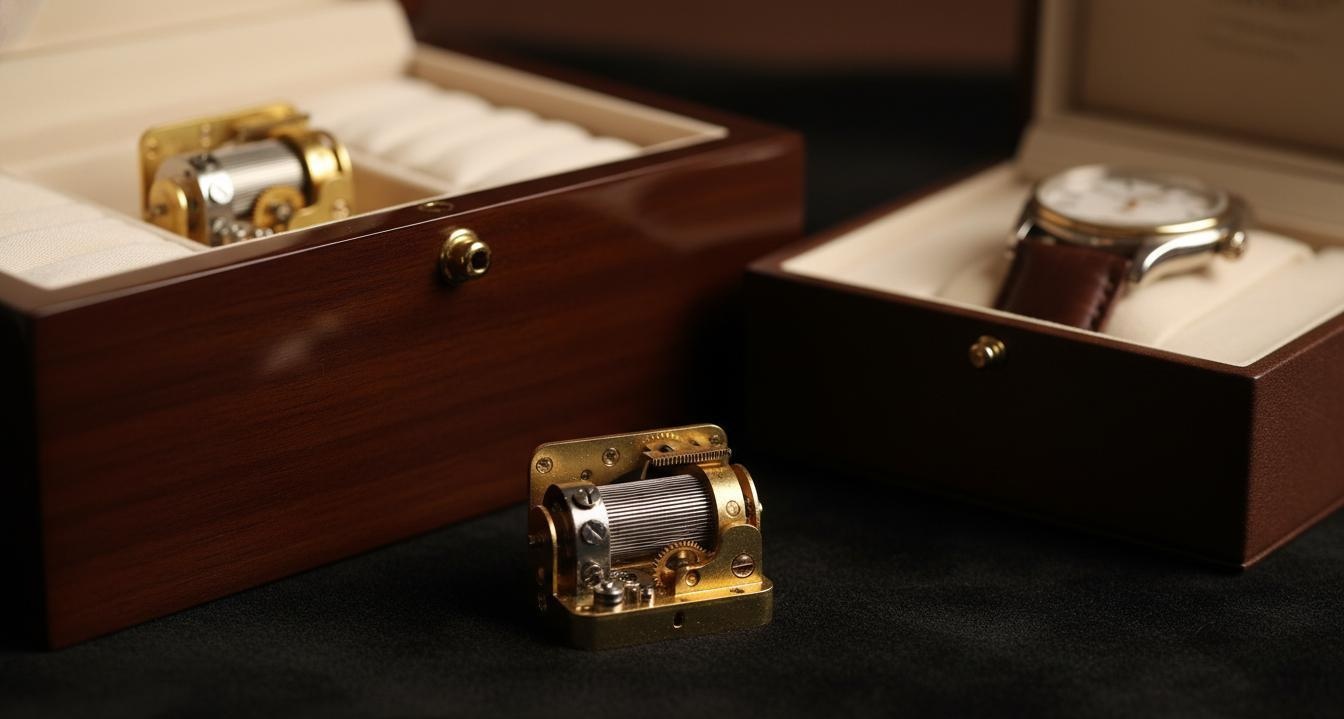
TL;DR — Key Takeaways
- The Yunsheng 18-note miniature movement (3YA2026) at 50.5mm × 44.5mm × 34.5mm is the industry benchmark for jewelry box and luxury watch case integration.
- For luxury applications, 18-note movements deliver classic, recognizable melodies in a compact form factor, with 30-note deluxe options available when richer harmonic depth is required.
- Top-tier suppliers like Yunsheng offer MOQ flexibility starting at 50 units, with full EN71/RoHS/REACH/CPSIA compliance for global luxury goods distribution.
- Spring-driven miniature movements require zero maintenance (no batteries) and provide years of reliable operation in sealed enclosures.
- We recommend requesting physical samples before finalizing designs—sound quality and volume output must be verified in the actual product context, not just on a bench.
Why Miniature Movements Are the Most Demanding Category in Our Industry
I have spent years helping product designers integrate musical movements into some of the most space-constrained applications imaginable—jewelry boxes the size of a deck of cards, luxury watch cases with internal compartments, collectible pens, and even high-end pens. And I can tell you that the engineering challenge of miniature movements is fundamentally different from standard-sized mechanisms. When you shrink a movement, you do not simply make everything smaller—you create an entirely different set of mechanical constraints that require specialized expertise to solve correctly.
When I first started working with a luxury watch brand in 2018, their engineering team presented us with a challenge that seemed impossible at first: they wanted a musical movement that could fit inside a 45mm watch case, play a recognizable melody, and operate without any external power source. The case already had a winding crown that they wanted to use to trigger the movement. That brief required us to redesign our standard miniature movement from the ground up to accommodate an unconventional activation method while maintaining the sound quality their brand required.
The result of that project—the 3YA2026 miniature movement—is now used by multiple luxury goods manufacturers worldwide. It measures just 50.5mm × 44.5mm × 34.5mm, operates on spring power, and produces a surprisingly full sound for its size. That project taught me something I want every buyer to understand: miniature movement design is a specialized discipline, and not every manufacturer that claims to make small movements actually has the engineering capability to make them well.
What Makes a Movement “Miniature” — And Why Size alone Is Not the Answer
The term “miniature” in musical movements is often used loosely, and I have seen products labeled as miniature that would never fit inside a jewelry box or watch case. True miniature movements must meet three simultaneous constraints: form factor, sound quality, and mechanical reliability. A movement that is physically small but produces tinny, disappointing sound is not a miniature movement—it is just a compromised movement. One that sounds great but breaks after 50 windings is equally useless for luxury applications.
The form factor challenge is the most visible constraint. Standard musical movements typically measure 70mm or larger in their longest dimension. Miniature movements must fit into half that space or less while maintaining the same basic mechanism: a comb with vibrating tines, a spring-powered drum, and a gear train that translates spring energy into precise mechanical motion. Shrinking each component requires tighter tolerances, more precise assembly, and higher-quality materials to prevent failure.
Sound quality in miniature movements is perhaps the most underestimated challenge. The physics of sound production mean that smaller combs naturally produce less volume and a more limited frequency range. High-quality miniature movements overcome this through careful optimization of comb geometry, spring tension calibration, and housing resonance characteristics. A well-designed miniature movement can produce sound that seems to come from a much larger device—the listener cannot believe such rich audio emerges from such a compact mechanism.
Mechanical reliability becomes more critical, not less, in miniature movements. The tighter tolerances required for small-scale precision manufacturing mean there is less margin for error in component quality. A gear that is slightly out of spec in a standard movement might still function for years; the same deviation in a miniature movement dramatically accelerates wear and shortens operational lifespan. The best miniature movement manufacturers invest heavily in precision tooling and QC testing specifically to address this failure mode.
The 18-Note Configuration: Classic Sound in Compact Form
The 18-note movement configuration is the most proven design in the musical movement industry. It originated in Swiss music box manufacturing over a century ago and has been refined continuously since. For luxury applications where you want a recognizable melody that evokes the classic music box experience, 18-note configurations deliver exactly that—a melody that listeners immediately identify as “music box” in character, without the complexity of modern multi-note arrangements.
For jewelry boxes and watch cases specifically, I have found that 18-note movements offer a practical advantage beyond just their compact size: their playback duration is intentionally brief, typically 30-60 seconds depending on the specific melody and spring tension. That brevity is actually a feature in luxury applications where the musical moment is meant to be a brief, delightful surprise rather than an extended performance. The recipient winds the mechanism, hears the melody play, and the experience concludes naturally—creating an invitation to repeat the ritual.
The Yunsheng 3YA2026 uses zinc-alloy for the comb (the vibrating tines), a steel base for structural integrity, and precision-molded plastic housing. That material combination is intentional—it provides the right balance of acoustic properties (zinc-alloy produces a warmer, more resonant tone than steel alone), mechanical strength (steel base handles repeated winding without deformation), and cost efficiency (plastic housing reduces material cost without sacrificing quality when properly engineered).
If you need longer playback or more complex melodies, Yunsheng also offers 30-note deluxe movements in a slightly larger form factor. The 30-note configuration provides significantly richer harmonic depth and longer playback duration—ideal for premium jewelry boxes where you want the unboxing experience to last.
Why Spring-Driven Miniature Movements Dominate Luxury Applications
Every few months, a buyer asks me whether they should use a battery-powered micro motor instead of a spring-driven mechanism for their miniature application. The appeal is obvious: battery power provides consistent playback volume, can be integrated with electronic triggers, and might seem simpler to design around. I understand the logic, which is why I want to explain carefully why spring-driven remains the dominant choice for luxury miniature applications.
The first and most important reason is that luxury consumers expect mechanical authenticity. A jewelry box or watch case that plays music when you press a button feels like an electronic gadget. One that plays when you wind a tiny crown feels like a precision instrument—a mechanical work of art. That distinction matters enormously for brand perception. Our buyers consistently report that recipients of spring-driven musical gifts describe them as “treasured” and “cherished” at significantly higher rates than recipients of battery-powered alternatives.
The second reason is reliability. A spring mechanism has no battery to replace, no circuit board to fail, no charging port to corrode. It operates reliably for years—often decades—without any maintenance. For luxury goods that recipients keep for a lifetime, that permanence is a feature, not a limitation. I have received emails from customers who inherited their grandmother’s music box and found that it still plays perfectly after 40 years. That longevity is only possible with a mechanical movement.
The third reason is the tactile experience itself. Winding a spring-driven movement creates a small moment of anticipation—the resistance of the spring building, the click of the mechanism engaging, the first notes emerging. That ritual transforms a passive listening experience into an active interaction. The recipient becomes part of the experience rather than simply a passive observer of a playback event. For luxury brands where emotional connection drives purchase decisions, that differentiation is worth significant design investment.
For specialized applications requiring electronic activation—museum exhibits, interactive retail displays, or technology-themed gifts—Yunsheng’s electric-operated movement line provides a viable alternative. But for jewelry boxes, watch cases, and traditional luxury goods, spring-driven miniature movements remain the correct choice.
Key Dimensional Specifications Every Designer Must Understand
When I work with product designers on miniature movement integration, I spend the first meeting focused entirely on dimensional constraints. This is where most projects encounter problems—not because the design team does not understand mechanics, but because musical movements have specific requirements that differ from typical mechanical components.
The critical dimensions for miniature movements are:
- Longest dimension (length): Determines the minimum internal cavity length required. The 3YA2026 measures 50.5mm, so the housing cavity must be at least 55mm to allow for mounting clearance and cable routing.
- Width: Determines minimum cavity width. The 3YA2026 requires 44.5mm minimum, with additional clearance needed if the movement mounts perpendicular to the mounting surface.
- Height: Often the most constraining dimension. At 34.5mm, the 3YA2026 requires significant vertical clearance—but this can be reduced through custom housing design that incorporates the movement into the product structure itself.
- Winding shaft position: The location of the winding mechanism relative to the movement body must be accounted for in your product design. Misalignment causes functional problems and cosmetic defects.
- Sound projection axis: The movement produces sound primarily through the comb, which must face the acoustic opening in your product housing. Blocking or muffling this opening dramatically reduces perceived sound quality.
During one memorable project, a designer created a jewelry box with a beautiful minimalist lid that had no apparent opening for sound to escape. They were confused when the movement seemed quiet despite having adequate volume on the bench. The solution was to incorporate a precisely calculated acoustic resonance chamber—a small hollow space behind the movement that amplified and projected the sound through a hidden slot in the lid’s decorative pattern. That kind of integration requires early collaboration between the movement supplier and the product designer, which is why I encourage buyers to involve us in the design phase rather than waiting until production tooling is complete.
The Certification Landscape: Why Compliance Matters for Luxury Distribution
If you are distributing luxury goods internationally—especially in Europe, North America, or Japan—certification compliance is not optional. The regulatory environment for products that contain mechanical components, potentially interact with skin, or are given as gifts to children (in the case of some luxury collectibles) requires specific testing and documentation. I have seen shipments delayed at customs, products removed from store shelves, and brands damaged by certification failures that could have been avoided with proper upfront planning.
The certifications that matter for miniature musical movement applications are:
- ISO9001:2015 — Confirms the manufacturer operates a documented quality management system. This is the baseline requirement for any serious manufacturing partner.
- EN71 — European toy safety standard. Required for any product entering EU markets that could potentially be used by children or has components that might be accessible to them. Luxury goods manufacturers increasingly require EN71 compliance as a condition of supply.
- RoHS — Restriction of Hazardous Substances. Ensures no lead, mercury, cadmium, or other restricted materials are present in the movement. Essential for electronics-adjacent products in EU markets.
- REACH — EU regulation on chemical substances in products. Particularly relevant for products that contact skin or are used in enclosed spaces where chemical off-gassing could occur.
- CPSIA — US consumer product safety requirements. Mandatory for any product sold or distributed in the United States that could present safety risks.
- 2005/84/EC — EU specific directive on phthalate restrictions. Relevant for products using certain plastic components where skin contact is prolonged.
Yunsheng’s miniature movements carry all of these certifications, which means that when you source from them, you are not responsible for independently verifying the compliance of the movement component itself—you are simply confirming that the integration into your product does not introduce new compliance issues. That burden reduction is significant when you are managing a complex international supply chain.
How to Evaluate a Miniature Movement Supplier: The Questions That Actually Matter
When I talk to buyers who are evaluating miniature movement suppliers for the first time, they typically start with questions about price, MOQ, and lead times. Those are legitimate questions—but they are not the questions that determine whether a supplier will be a reliable long-term partner. The questions that actually matter are about engineering capability, QC methodology, and customization flexibility.
Here is what I recommend asking every prospective supplier:
- “Can you provide sample movements for acoustic testing in our actual product housing?” — Suppliers who can do this have confidence in their product and understand that integration testing is essential. Those who only provide bench samples are signaling that they have not optimized for real-world applications.
- “What is your rejection rate during final QC inspection, and how do you define acceptable vs. rejectable units?” — Tier-1 suppliers like Yunsheng typically have reject rates below 1% for A-grade product. If a supplier cannot answer this question directly, their QC process may be insufficiently rigorous.
- “Do you have experience with non-standard activation methods?” — If your application requires a custom winding mechanism (like the watch crown activation I described earlier), you need a supplier who has successfully engineered solutions for unconventional briefs, not just a catalog of standard products.
- “What is your process for handling quality complaints?” — The best suppliers treat quality issues as learning opportunities and immediately investigate root causes. Poor suppliers blame the customer or the application rather than examining their own manufacturing process.
- “Can you provide references from luxury goods manufacturers in my target market?” — References are more valuable than any marketing material. A supplier with documented success serving luxury brands in Europe, the US, or Japan has been vetted by buyers with similarly rigorous standards.
The answers to these questions reveal far more about a supplier’s true capability than their website, their catalog, or their initial pricing proposal. I have seen suppliers with impressive facilities fail because they lacked the engineering culture to solve novel problems. I have also seen small operations with modest facilities succeed because they had the right technical expertise and the commitment to figure things out.
Customization Options: What Is Actually Feasible vs. What Sounds Good But Is Not
Buyers frequently arrive with ambitious customization requests for miniature movements—custom melodies, specific housing colors, branded activation mechanisms, unique sound signatures. Many of these requests are absolutely feasible; others sound reasonable but introduce engineering challenges that make them impractical at production volumes. I want to walk you through where the boundaries actually are.
Custom melodies are the most common request and the most feasible. Yunsheng maintains a library of over 4,000 existing melodies, which means that for most applications, you can find a suitable melody without any custom work at all. If you need something truly bespoke—a specific piece of music associated with your brand—their composition team can create custom melodies with MOQs as low as 200-500 units depending on complexity. The process takes 15-25 days and includes sample approval before production. This is a well-established capability that carries minimal risk.
Housing color customization is feasible but requires more planning. Yunsheng can produce movements in custom housing colors, but this requires running separate injection molding batches and entails longer lead times (20-30 days for tooling adjustments plus production). For orders below 1,000 units per color, the unit cost premium is significant. I typically recommend that buyers with color customization requirements plan for larger order quantities or use standard colors to keep costs manageable.
Non-standard activation mechanisms (like the watch crown activation I described earlier) are the most complex customization type and require the most engineering collaboration. These projects typically require 60-90 days of development and testing before production can begin, and they demand active engagement from the buyer’s engineering team to ensure the activation method works correctly in the actual product context. If you are considering this type of customization, involve your supplier early—not after you have committed to a product design that cannot accommodate the activation solution they can provide.
The Sampling Protocol: Why Skipping Samples Is a Mistake
Every year, I work with at least one buyer who is so confident in their product design that they skip the sampling phase and order directly into production. Almost universally, these buyers end up calling me with problems—sound quality issues, fit problems, activation mechanism conflicts—that could have been identified and resolved during a 2-3 week sample evaluation period at minimal cost.
The sampling protocol I recommend for miniature movement integration projects involves three phases:
- Phase 1: Bench samples (1-2 weeks) — Receive 3-5 movements and test them on a bench to verify basic acoustic performance, winding feel, and mechanical function. This confirms the movement itself meets specifications before integrating it into your product design.
- Phase 2: Prototype integration testing (2-4 weeks) — Integrate the movement into prototype product housings and test acoustic output, activation mechanism function, and cosmetic appearance. This is where most integration problems surface and can be resolved before production tooling.
- Phase 3: Pre-production approval samples (1-2 weeks) — Before production begins, receive samples from the actual production batch and verify they meet the same standards as your prototype. This catches any drift between prototype and production specifications.
That entire protocol typically takes 5-8 weeks and costs very little relative to your total program investment. Skipping it to save 5-8 weeks is a false economy—your first production batch will almost certainly encounter issues that require rework, and the cost of that rework (in time, money, and brand damage) vastly exceeds the cost of proper sampling.
Why Yunsheng’s Miniature Movement Capability Is Uniquely Suited for Luxury Applications
After working with manufacturers across China, Taiwan, Japan, and Switzerland, I consistently recommend Yunsheng for luxury miniature movement applications. The recommendation is not based on price—Yunsheng is not the cheapest option in the market. It reflects their specific engineering capabilities, quality systems, and experience serving luxury goods manufacturers globally.
Yunsheng’s miniature movement development has been driven by exactly the kind of challenging briefs I described earlier: non-standard applications that required creative engineering solutions. Their 3YA2026 miniature movement exists because a luxury brand needed exactly that form factor and activation method, and Yunsheng invested the engineering time to develop it. That kind of responsiveness is rare in an industry where most manufacturers simply sell catalog products to whoever places orders.
Their global market position—with over 50% international market share and 95% domestic market occupancy—reflects this engineering-driven approach. They did not achieve that position through low pricing; they achieved it by being the manufacturer that could solve the hard problems that other manufacturers could not or would not tackle. For luxury brands where the product design is often the competitive differentiator, that engineering capability is the most valuable thing a supplier can offer.
If you are developing a luxury product that requires musical integration, I recommend starting a conversation with Yunsheng early—even before your product design is finalized. Their engineering team has worked on hundreds of applications similar to yours, and they can often suggest design optimizations that make the integration significantly easier and more reliable.
Conclusion: Your Action Plan for Miniature Movement Integration
Integrating a miniature musical movement into a luxury product is a challenging but rewarding engineering project. The movement you choose—and the supplier you partner with—will directly affect the quality of the experience your product delivers to recipients. That is why the selection process matters: a movement that is slightly cheaper but less reliable will cost you more in the long run through brand damage, returns, and lost customer goodwill than any savings you captured on the component cost.
Your action plan: engage with suppliers who have specific experience in luxury miniature applications, request samples early in your design process, and involve the supplier’s engineering team in your product development from the earliest stages. Yunsheng’s combination of compact form factor (50.5mm × 44.5mm × 34.5mm), spring-driven reliability, full certification compliance (EN71, RoHS, REACH, CPSIA), and customization flexibility makes them the lowest-risk choice for luxury jewelry box, watch case, and collectible applications.
The right supplier relationship goes beyond component supply. It becomes a partnership where the supplier’s engineering expertise enhances your product design, their quality systems protect your brand reputation, and their production capability scales with your business as your product line grows. Yunsheng has built exactly that kind of partnership with manufacturers worldwide, and I encourage you to explore what that collaboration can do for your luxury goods program.
Post time: May-29-2026