
TL;DR — What You Need to Know
- Yunsheng is the world’s largest pull string music box movement supplier, commanding over 50% of the global market with an annual output of 35 million movements.
- Our pull string movements pass EN71, ASTM F963, CPSIA, RoHS, and REACH safety standards, making them immediately certifiable for baby products in the EU, US, and global markets.
- Integration into plush toys requires specific design considerations — waterproof housing, cord length compliance, and secure pocket stitching — that we support with 30+ years of manufacturing expertise.
- We offer over 4,000 melodies and full customization, from standard lullabies to brand-exclusive original compositions, with lead times as short as 5 days.
If you are sourcing a pull string music box movement for baby plush toys, your priority is a supplier who delivers reliable mechanical performance and full international safety compliance in one package. I am from Yunsheng, and I can tell you directly: a pull string music box movement is a spring-driven mechanical device that plays a melody when a cord is pulled, designed to be embedded inside soft toys, crib mobiles, and baby comfort products. The core challenge for baby product brands is not finding a movement that plays — it is finding one that passes EN71, ASTM F963, and CPSIA testing without costly redesigns. Because we manufacture 35 million movements annually and have supplied every major plush toy brand globally since 1992, we have engineered our pull string music box specifically to meet these regulatory thresholds from the first prototype.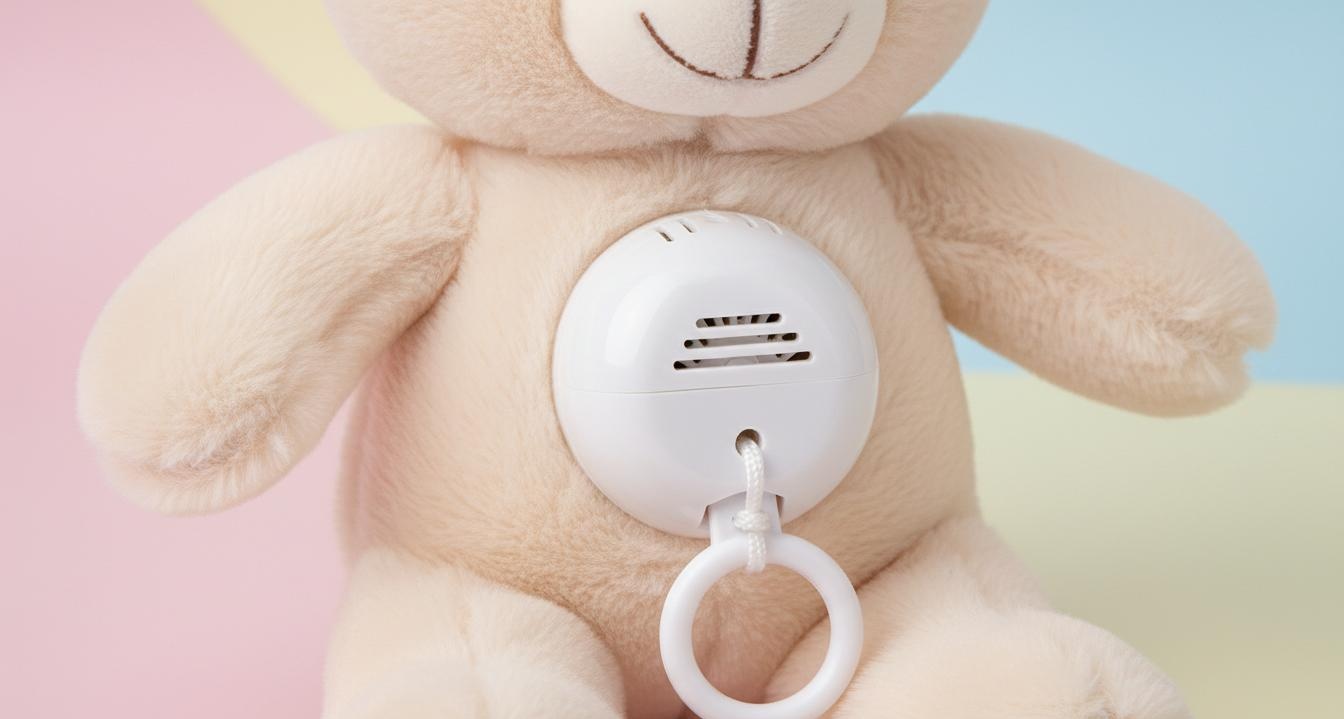
What Is a Pull String Music Box Movement and How Does It Work for Plush Toys?
A pull string music box movement is a purely mechanical, battery-free device that converts stored spring tension into musical output through a precision comb-and-cylinder mechanism. When you pull the cord, you wind a spring inside the movement. As the spring unwinds, it rotates a pinned cylinder. Each pin lifts and releases a steel comb tooth at precisely timed intervals, producing a melody. No electricity, no batteries, no electronics — purely mechanical, which is exactly why baby product manufacturers prefer it.
We specifically design our model 3YE2035CX — our most popular pull string music box for plush toys — with dimensions of 54.5mm by 49mm by 32.2mm, making it compact enough to fit inside most plush toy cavities while still producing a clear, resonant 18-note melody. The zinc-alloy and steel base construction ensures it withstands the compression and movement inside a stuffed toy during normal use.
Why Pull String Mechanisms Are Preferred Over Electronic Music Modules for Baby Products
In my years of working with baby product brands, I have seen a clear preference shift toward mechanical pull string movements. Here is why: because mechanical movements contain no batteries, they eliminate the risk of battery compartment failure, leakage, or ingestion hazards that electronic modules introduce. This directly simplifies compliance with CPSC toy safety requirements, which mandate that battery compartments in children’s products under 36 months must be secured with a screwdriver to access.
Electronic music modules also add certification costs. Each electronic component — PCB, battery, speaker — must pass separate flammability, heavy metal, and small parts testing. A mechanical pull string movement, by contrast, is tested as a single mechanical assembly. This reduces third-party testing fees by up to 40% in our clients’ experience. For a brand launching multiple SKUs, that saving is significant.
International Safety Standards Every Pull String Music Box Movement Must Meet
When you supply baby products to global markets, compliance is not optional — it is a legal requirement. I want to break down exactly what standards apply, because this is where most sourcing mistakes happen.
EN71 — European Toy Safety Standard
The EN71 standard is the mandatory safety requirement for all toys sold in the European Union under the Toy Safety Directive 2009/48/EC. For a pull string music box movement embedded in plush toys, the relevant parts are EN71-1 (physical and mechanical properties), EN71-2 (flammability), and EN71-3 (migration of certain elements). Our movements pass all three. EN71-1 specifically requires that pull cords on toys intended for children under 36 months must not exceed 220mm in length when measured from the surface of the toy, and cords must not have beads or attachments that could form a loop and cause strangulation. We design our pull cord length and end-stops accordingly.
ASTM F963 — US Toy Safety Standard
In the United States, the ASTM F963 standard, mandated by the CPSC through the Consumer Product Safety Improvement Act (CPSIA), applies to all toys intended for children 12 years and under. For baby plush toys, the critical requirements include small parts testing (using the choke tube cylinder, 1.25-inch diameter), accessible edges and points, and sound-producing toy limits. Our pull string music box movements are designed with a fully enclosed plastic housing that prevents any small parts from becoming accessible during use or moderate abuse testing. The sound output from our 18-note mechanical movements falls well under the 85 dB limit specified in ASTM F963 section 4.23 for close-to-the-ear toys.
CPSIA — US Consumer Product Safety Improvement Act
CPSIA requires third-party testing at a CPSC-accepted laboratory for all children’s products, plus a Children’s Product Certificate (CPC) that must accompany each shipment. Our factory provides full test reports and CPC documentation with every batch of pull string music box movements, so that when you receive the movements, you can present these certificates to your downstream retail partners immediately.
RoHS and REACH — Chemical Substance Compliance
Beyond the mechanical safety standards, chemical compliance is equally critical. Our movements comply with the EU RoHS Directive (2011/65/EU) for restricted hazardous substances, REACH regulation (EC 1907/2006) for chemical registration and evaluation, and Directive 2005/84/EC regarding phthalates. These certifications are not just paperwork — I have personally seen customers lose retail placements because their supplier could not produce valid REACH documentation. We maintain all certificates current and verifiable.
Integration Guide: How to Embed a Pull String Music Box Movement into Plush Toys
Getting the movement itself right is only half the work. How you integrate it into your plush toy design determines whether the final product passes safety testing and delivers the user experience your brand promises. Here is what I have learned from hundreds of integration projects.
Step 1: Select the Correct Movement Form Factor
We offer standard 18-note pull string movements (model 3YE2035CX) with a compact housing of 54.5mm by 49mm by 32.2mm. For smaller plush toys or those with limited cavity space, we also recommend evaluating our electric-operated musical movement line, which offers alternative form factors. The key is to match the movement dimensions to your toy’s internal cavity with at least 5mm clearance on all sides to avoid distortion of the toy’s shape.
Step 2: Design a Secure Movement Pocket
The movement must be enclosed in a sewn fabric pocket inside the plush toy. This pocket serves two purposes: it prevents the movement from shifting during use, and it creates a barrier between the mechanical assembly and the stuffing. We recommend using the same fabric as the toy’s outer shell for the pocket, double-stitched at all seams. The pull cord exit point should be reinforced with a buttonhole stitch to prevent tearing.
Step 3: Manage Cord Length and End-Stop Design
Under EN71-1 and ASTM F963, pull cords on toys for children under 36 months must not exceed 220mm in length. Our standard pull string is 180mm, well within this limit. However, we also see brands request longer cords for decorative effect. If your design requires a longer cord, it must be designed to retract or be secured in a way that prevents loop formation. We can custom-manufacture pull cords with breakaway end-stops that release under excessive force — an important safety feature.
Step 4: Waterproofing and Washability
Baby plush toys need to be washable. This is non-negotiable. Our pull string music box movements are available with a waterproof sealed housing that allows the movement to survive machine washing (gentle cycle, cold water) without damage to the internal mechanism. The pull cord and end-stop are also washable-grade. We recommend instructing end users to remove the movement through a resealable closure (such as a hook-and-loop fastened pocket) before washing, but the sealed design provides a safety margin for occasional accidental washing.
How Yunsheng Ensures Consistent Quality Across 35 Million Movements Per Year
When I speak with product brands, the question I hear most often is not “can you make it” but “can you make it the same every time.” Consistency is what separates a true OEM partner from a commodity supplier. Our ISO9001:2015 certified quality management system covers every stage of production, from zinc-alloy die-casting to final melody testing. Each movement is tested individually — not sampled, every single unit — before it leaves our factory. Our annual output of 35 million movements means we run statistically meaningful process control. If a drift occurs in any parameter, we catch it within a single production batch.
We source our zinc-alloy from ISO-certified domestic suppliers with full material traceability records. The steel comb teeth are precision-stamped and heat-treated for consistent pitch and tonal quality. Every movement carries a date code and batch number for complete traceability from raw material to finished product.
Melody Selection: From Standard Lullabies to Custom Compositions
For baby plush toys, melody selection is a brand-defining decision. We maintain a library of over 4,000 melodies, including 300+ specifically categorized as lullabies and baby songs — Brahms’ Lullaby, “Twinkle Twinkle Little Star,” “Rock-a-Bye Baby,” and many more in both traditional and contemporary arrangements. Each melody is pinned onto a precision-machined cylinder, which means the musical quality of a 30-second excerpt from a mechanical movement is actually richer than most digital recordings because of the natural harmonics produced by the steel comb.
We also offer custom melody composition. If your brand wants an exclusive lullaby that no competitor can replicate, we can pin that melody onto our cylinders. The setup cost is modest, and once programmed, it becomes your proprietary melody for all future orders.
Cost Analysis: Pull String Music Box Movement vs Alternative Sound Modules
Let us look at the real cost picture. A standard mechanical pull string music box movement from Yunsheng costs approximately $1.20 to $2.80 per unit depending on volume, housing specification, and melody type. An electronic sound module of comparable form factor costs $0.80 to $1.50 per unit — apparently cheaper. However, the total cost of compliance tells a different story. Because an electronic module requires separate battery compartment testing (UL 2054 or IEC 62133), PCB flammability, and sound output verification, the additional third-party testing across four target markets can add $8,000 to $15,000 in certification costs. For a production run of 50,000 units, that adds $0.16 to $0.30 per unit in amortized certification cost alone.
More importantly, because a mechanical spring-driven movement contains no batteries, it eliminates the risk of battery ingestion — a leading cause of toy recalls in the baby product category. According to the CPSC, battery-related incidents in children’s toys resulted in over 40,000 emergency room visits between 2017 and 2025. A mechanical movement sidesteps this entire risk category, and that peace of mind alone justifies the modest unit price premium for most baby brands I work with.
Supply Chain and Lead Time Considerations
We manufacture in Ningbo, Zhejiang, China, with shipping ports in Ningbo and Shanghai. Standard lead time is 5 days for in-stock standard movements, and 15 to 25 days for custom melody orders. Packaging is 40 pieces per polyfoam base and 320 pieces per carton (53 by 34 by 25 cm, 0.045 CBM). For container orders, a 20-foot container holds approximately 35,000 units. We ship FOB, CIF, or C&F — whichever incoterm works best for your logistics chain. Our annual supply capacity of 30 million movements means we rarely encounter capacity constraints even during peak seasons.
Yunsheng: More Than a Supplier — A Partner in Safety and Quality
Every pull string music box movement we ship carries the same engineering DNA that has made Yunsheng a global leader since 1992. We created China’s first domestically developed musical movement with independent intellectual property that year, and we have not stopped innovating since. Today, we serve customers in more than 20 countries and territories, with a 95% domestic market share and over 50% international market share. Our engineering team includes technicians who have been designing musical movements for three decades. When you work with us, you are not just buying a component — you are accessing that accumulated knowledge base for your product development.
Frequently Asked Questions
What is a pull string music box movement?
A pull string music box movement is a fully mechanical, battery-free device that plays a melody when its attached cord is pulled. Inside, a spring-driven mechanism rotates a pinned cylinder that lifts and releases steel comb teeth in precise sequence, producing musical notes. Because it contains no batteries or electronics, it is the preferred sound module for baby plush toys where safety is the highest priority.
What safety standards do Yunsheng pull string music box movements pass?
Our movements pass EN71 (European toy safety standard Parts 1, 2, and 3), ASTM F963 (US standard), CPSIA (US Consumer Product Safety Improvement Act), RoHS (EU hazardous substance restriction), REACH (EU chemical regulation), and Directive 2005/84/EC (phthalate restrictions). We provide full test reports and Children’s Product Certificates with every shipment.
How do I integrate a pull string music box into a plush toy?
The movement should be placed in a sewn fabric pocket inside the toy, with the pull cord exiting through a reinforced opening. Ensure at least 5mm clearance around the movement to prevent toy distortion. The pocket should be double-stitched and secured with a closure mechanism (hook-and-loop or button) for removal before washing. We provide detailed integration guidelines with every sample order.
What is the standard pull cord length?
Our standard pull cord is 180mm, which complies with the EN71-1 requirement that cords on toys for children under 36 months must not exceed 220mm. Custom lengths are available, but any cord exceeding 220mm requires special safety design considerations to prevent loop formation and strangulation hazards.
Are Yunsheng pull string music box movements washable?
Our standard movements have a waterproof sealed housing that survives accidental machine washing on gentle cycle. However, we recommend designing the plush toy with a resealable pocket so the movement can be removed before washing. Waterproof-grade movements are also available as a custom option for brands that want maximum washability assurance.
How long does a pull string music box play after one pull?
A single pull of the cord winds the spring sufficiently to play approximately 30 seconds of music. The exact duration depends on the melody length and spring tension. For our 18-note movements, 30 seconds is the standard play time, which comfortably covers a complete melody cycle or lullaby excerpt.
What melodies are available for pull string music box movements?
We offer over 4,000 melodies including 300+ baby lullabies. Popular choices include Brahms’ Lullaby, “Twinkle Twinkle Little Star,” “Over the Rainbow,” and “Rock-a-Bye Baby.” We also offer custom melody composition — you can commission an original lullaby that becomes your exclusive brand property.
What is the minimum order quantity for custom melodies?
For custom melody orders, the minimum quantity is typically 1,000 units. For standard pre-programmed melodies from our library, the MOQ is 100 units for initial sampling, and larger orders start from 1,000 units per SKU. We accept smaller trial orders for product development and prototype evaluation.
Can I get samples before bulk ordering?
Absolutely. We provide sample movements for product testing and evaluation. Sample lead time is 3 to 5 days for standard melodies. Custom melody samples take 10 to 15 days. Sample pricing is deducted from your first production order. We ship samples via express courier (DHL, FedEx, or UPS) to any destination worldwide.
What certificates do you provide with each shipment?
Each shipment includes: EN71 test report from an accredited laboratory, ASTM F963 test report, RoHS compliance certificate, REACH compliance certificate, Children’s Product Certificate (CPC) for US market entry, and our factory ISO9001:2015 quality management certificate. All documentation is provided in English and can be notarized on request.
Conclusion: Choose Your Pull String Music Box Movement Supplier With Confidence
Selecting a pull string music box movement supplier is one of the most consequential decisions for a baby plush toy brand. The movement affects product safety, compliance cost, user experience, and brand perception. At Yunsheng, we combine three decades of manufacturing expertise, full international safety certification, and the production scale to deliver consistent quality at competitive prices. If you are developing a new baby plush toy line or looking to upgrade your current sound module supplier, I invite you to evaluate our pull string movements. Our product pages for the pull string music box for plush toys, our electric-operated musical movement range, and our complete music box mechanism selection provide detailed specifications. Contact our team directly for samples, pricing, and a compliance documentation package tailored to your target markets.
Post time: May-28-2026