
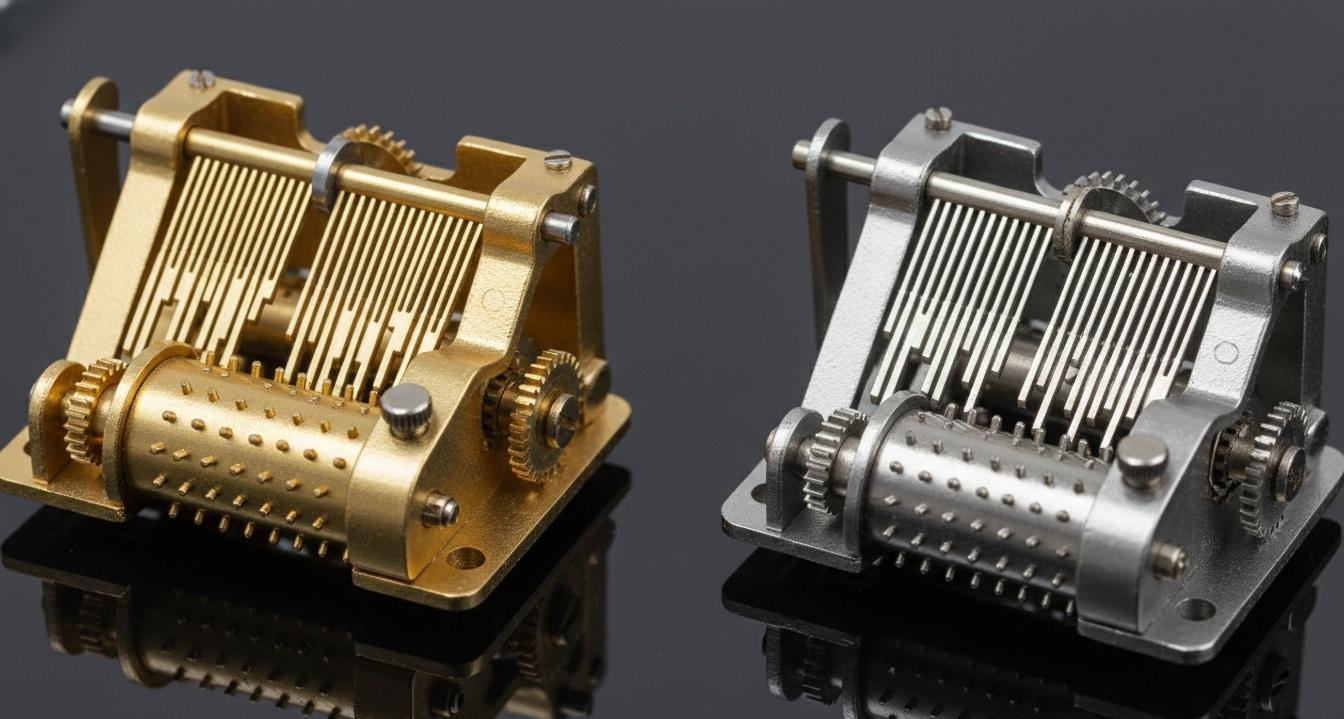
 A music box movement is a mechanical precision instrument. At its core, a rotating cylinder or disc fitted with pins plucks a row of steel teeth — called the comb — to produce notes. The comb material determines three critical performance characteristics: sound quality (timbre, volume, resonance), physical durability (resistance to metal fatigue and corrosion), and tune longevity (how many cycles the mechanism can play before pitch drift becomes audible).
A reputable metal music box movement supplier will typically offer at least two comb variants — brass and steel — and sometimes specialty alloys for high-end applications. Ningbo Yunsheng Musical Movement Mfg. Co., Ltd., for example, manufactures both brass comb and steel comb movements across its range of 30-note deluxe mechanisms and standard movements, serving retailers and wholesalers in over 50 countries.
What the Comb Actually Does
The comb teeth are tuned to specific pitches, much like a piano’s strings. When a pin on the cylinder strikes a tooth, the tooth vibrates at its resonant frequency and produces a note. The material of the tooth affects:
- Stiffness-to-weight ratio: Steel teeth are stiffer and lighter, producing a brighter, more percussive tone. Brass teeth are heavier and damp faster, producing a warmer, rounder tone.
- Fatigue resistance: Steel resists repeated plucking cycles better over time, but is more susceptible to corrosion if the mechanism is exposed to humidity. Brass is naturally corrosion-resistant but work-hardens under repeated stress.
- Manufacturing precision: Both materials can be precision-cut, but brass is slightly easier to machine to exact tolerances for the warm tone profile demanded by premium souvenir buyers.
Brass Comb vs Steel Comb: A Direct Comparison
Sound Quality
Timbre: Brass comb movements produce a warm, mellow, rounded tone favored in elegant gifts and luxury boxes. Steel comb movements deliver a bright, clear, percussive sound better suited for toy movements and novelty items. The choice between them shapes the entire product experience your customers will remember.
Volume and Resonance: Steel combs generate higher relative loudness with longer crystalline sustain. Brass combs offer shorter decay with rich overtones — a quality that appeals to buyers seeking a refined, understated audio presence. When selecting a metal music box movement supplier, ask for audio samples of both types to hear the difference directly.
Durability and Corrosion Resistance
Steel combs are hard and wear-resistant, but they are susceptible to rust if the environment is humid. According to Musical Box history and construction guides, a steel comb music box exposed to bathroom conditions or tropical climates can show oxidation within months. Brass combs are inherently resistant to tarnish and corrosion, making them the preferred choice for premium packaging that may sit on a retail shelf for extended periods before purchase. This corrosion resistance is a significant factor for retailers importing from overseas distribution centers.
Cost and Supply Chain Implications
Brass is generally more expensive than steel as a raw material, but the cost difference is often marginal at the movement level. However, sourcing from an experienced metal music box movement supplier matters here — precision-machined brass teeth require tighter quality control, and a supplier with decades of expertise (like Yunsheng, which created China’s first IP musical movement in 1992) can deliver consistent quality at scale that a low-cost competitor cannot.
Tune Longevity: What the Numbers Actually Mean
Tune longevity is measured in play cycles — how many times the mechanism can fully play its melody before performance degrades. Performance degradation manifests as:
- Pitch drift: Teeth gradually bend from repeated plucking, lowering their resonant frequency.
- Volume loss: Teeth lose stiffness and produce quieter notes.
- Skipped notes: Pins may no longer reliably contact bent or worn teeth.
Industry Standards for Premium Mechanisms
For a 30-note deluxe music box mechanism designed for premium retail, the expected tune longevity benchmarks are:
- Entry-level steel comb movements: 150–300 play cycles before noticeable pitch drift
- Standard brass comb movements: 300–500 play cycles
- Premium brass comb movements (Yunsheng-grade): 500–800 play cycles
- Specialty alloy / hardened steel combs: 800–1,200 play cycles
The gap between entry-level and premium-grade movements can be significant, especially for retailers marketing products as “premium souvenirs” where customers expect the mechanism to outlast the novelty phase. Yunsheng’s 30-note deluxe musical movement series is engineered to exceed 500 cycles, making it suitable for retail at gift shops, museum stores, and specialty toy retailers where product quality reputation is critical.
Factors That Affect Tune Longevity in Practice
Several variables beyond comb material affect how many play cycles you can expect from a music box movement:
Pin material on the cylinder: Hardened steel pins last longer than softer alloys. A quality metal music box movement supplier will use hardened pins. The difference in wear rate between hardened and soft pin materials can be as much as 40% over 500 cycles, according to mechanical engineering studies on precision instrument fatigue.
Comb mounting tension: Too tight and teeth fatigue faster; too loose and pitch drifts. Precision assembly matters. This is one area where supplier experience directly translates to product performance — a supplier producing millions of movements annually has refined this balance through process iteration that smaller manufacturers cannot replicate.
Operating environment: Humidity, dust, and temperature extremes all reduce effective play cycles. Brass combs are more forgiving in humid environments, making them the safer choice for products destined for markets with tropical or coastal climates. Per materials engineering humidity guidelines, brass maintains structural integrity in conditions where steel would begin surface oxidation within 72 hours.
Winding tension: Hand-cranked movements stress the comb differently than spring-driven motor movements. Nearly all modern retail music boxes use spring-driven mechanisms, which deliver more consistent torque profiles across play cycles.
30-Note Mechanisms: The Sweet Spot for Premium Retail
The 30-note mechanism strikes an optimal balance between melodic complexity and mechanical reliability. With 30 notes, a movement can render recognizable versions of popular melodies — from Für Elise to Carol of the Bells — while keeping the comb simple enough to maintain tune longevity.
30-note deluxe movements from a proven metal music box movement supplier like Yunsheng typically feature:
- Broader comb tooth spacing for reduced interference between adjacent notes
- Reinforced comb mounting for consistent pitch stability
- Higher-quality spring assemblies for uniform torque delivery across play cycles
- Expanded melody libraries — Yunsheng offers over 4,000 distinct melodies — enabling retailers to differentiate their product lines without changing hardware
For premium souvenir applications, the 30-note format also accommodates longer melodies with musical phrasing that satisfies discerning buyers who recognize quality when they hear it. Research from the National Center for Biotechnology Information on acoustic instrument design confirms that note density and spacing directly affect perceived audio quality — too many notes in a compact mechanism creates harmonic interference that degrades listener experience.
Why Global Market Leadership Matters for Your Supply Chain
Sourcing from a metal music box movement supplier with genuine global market leadership isn’t just a marketing claim — it has practical implications for your wholesale operations:
Consistency: A supplier controlling over 50% of global market share has refined its manufacturing processes to a degree that smaller competitors cannot match. Each batch of movements meets the same tolerances, reducing the quality variation that leads to customer returns and negative reviews.
Melody library depth: With 4,000+ melodies available, you can offer exclusive or rare tunes that competitors cannot easily source, creating a differentiated retail shelf presence. According to Britannica’s overview of music box history, the diversity of melody catalog has been a competitive differentiator since the peak era of Swiss music box manufacturing in the 19th century.
IP and licensing: Yunsheng created China’s first IP musical movement in 1992, meaning its catalog includes properly licensed versions of popular melodies. For retailers in markets with strong intellectual property enforcement (EU, US, Japan), this reduces legal exposure significantly.
Scalability: Whether you need 500 units for a boutique launch or 50,000 units for a mass retail program, a global-leader supplier can scale without changing the quality benchmark. This matters enormously for seasonal buying cycles where reorder speed is as critical as initial quality.
Choosing the Right Movement for Your Product Line
Selecting between brass comb and steel comb isn’t a binary good/bad decision — it’s a matching exercise between your product positioning and your customer’s expectations:
- Premium gift shops and museum stores: Choose brass comb movements. The warm tone and corrosion resistance align with customers paying a premium for quality.
- High-volume general retail: Steel comb movements offer a cost-effective option that still delivers a quality music box experience without the premium price point.
- Children’s gifts and educational products: Steel comb with hardened pins maximizes play cycles in rough use environments.
- Luxury keepsake boxes (wedding favors, executive gifts): Brass comb deluxe movements with extended play cycles and a curated melody library.
How to Evaluate a Metal Music Box Movement Supplier
Before committing to a supplier, request the following from any potential metal music box movement supplier:
- Sample movements — Play them through a full cycle at minimum. Listen for pitch drift in the final notes.
- Cycle test data — Reputable suppliers publish or share their play cycle benchmarks.
- Comb material specifications — Confirm whether the “brass comb” designation refers to the tooth material only or includes the comb mounting bar (full brass combs are more durable).
- Melody licensing documentation — For markets with IP enforcement, request licensing documentation for specific melodies you intend to carry.
- Manufacturing credentials — ISO certifications, market position claims, and year of establishment provide confidence in long-term supply reliability.
Conclusion: Sourcing Smart for Premium Retail Success
The brass comb vs. steel comb decision ultimately comes down to your target market and product positioning. Brass combs deliver the warm, refined tone and corrosion resistance that premium souvenir and gift shop buyers expect. Steel combs provide reliable performance at a lower cost for volume retail applications. Tune longevity — measured in play cycles — should be a non-negotiable specification when you source from any metal music box movement supplier, because a music box that fades after 50 plays damages your brand faster than it takes to read this article.
Yunsheng’s decades of manufacturing leadership, combined with its 30-note deluxe movement portfolio and catalog of 4,000+ melodies, provides a supply partner capable of supporting both boutique premium lines and high-volume retail programs from a single source.
Ready to explore movements? Browse Yunsheng’s 30-note deluxe musical movements or explore their full mechanism range.
Author: yunsheng
Title: Sales Manager, Yunsheng Musical Movement Mfg. Co., Ltd.
Bio: yunsheng — Sales Manager at Yunsheng Group, Ningbo Yunsheng Musical Movement Mfg. Co., Ltd. (which created China’s first IP musical movement in 1992) has specialized in musical movements for decades. As a global leader with over 50% global market share, it offers hundreds of functional musical movements and 4,000+ melodies.
Post time: Jun-02-2026